
How to Use a Capo: Capo Chart and Tips
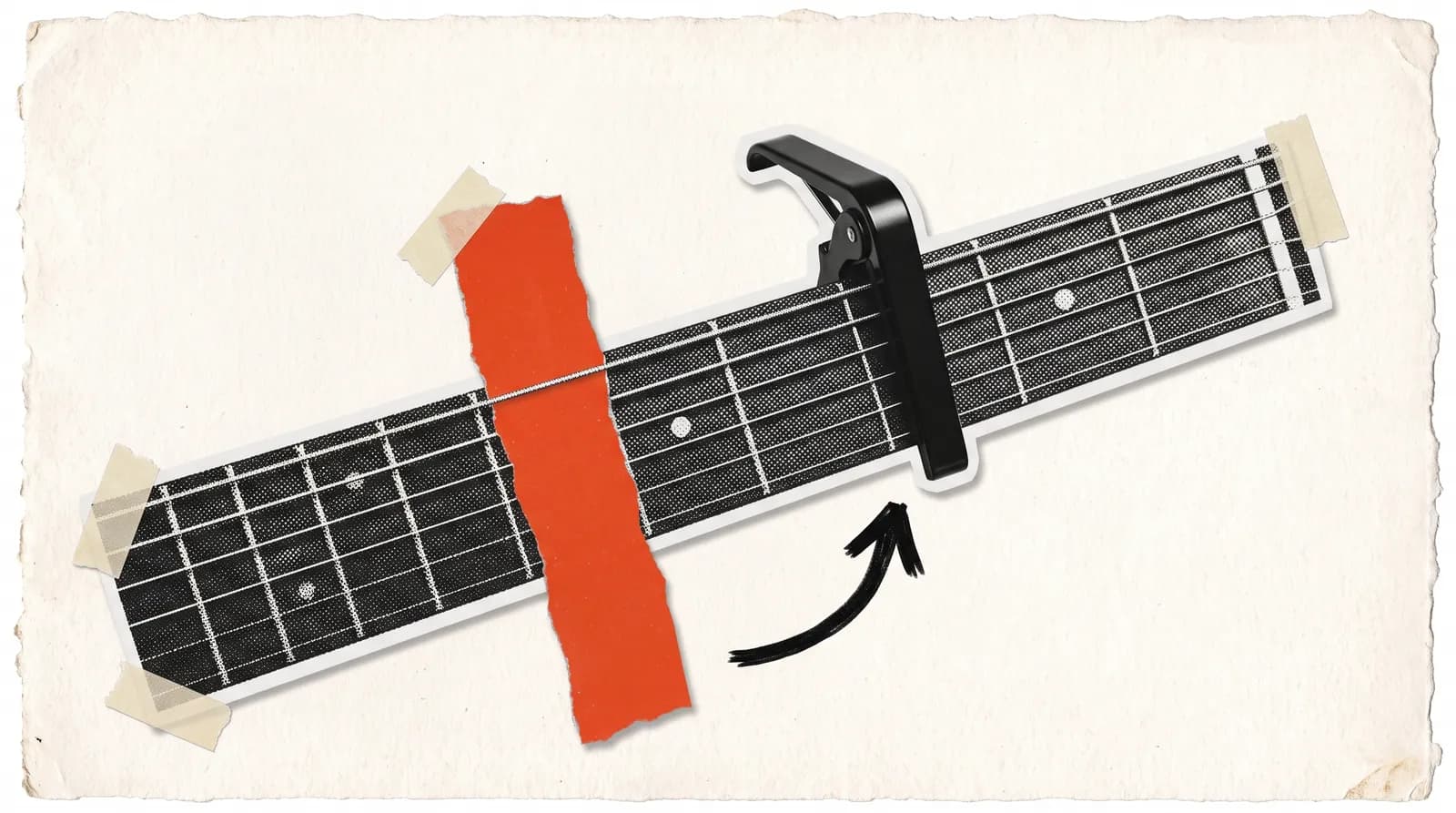
A capo is a clamp that goes on the guitar neck and holds all the strings down at the same fret. Wherever you put it becomes the new nut. Each fret raises the pitch by a half step. So you can play in another key with chord shapes you already know, without changing your fingering.
The singer wants the song a whole step higher. The original is G, C and D, and now it's in A, so the chords are A, D and E. Sounds simple, but all the open-string ringing, the little fills, the changes your fingers know, gone. Put a capo on the 2nd fret and you keep playing the same G, C and D shapes, and the song comes out in A.
A capo is about as simple as gear gets, but used carelessly in a band it causes real confusion. Here's how we use it, chart included.
What does a capo actually do?
A capo raises the pitch of your open strings. With a capo on the 2nd fret, the open low E string now plays F# and the open A string plays B. Chord shapes are counted from the capo. So "G shape" with a capo on 2 means the G fingering two frets above the capo.
A capo only goes up. It can't take you lower. If you want a song lower than the original, a capo alone won't do it. You either change the chord shapes or tune the guitar down.
There are a few types. Spring capos go on and off one-handed in a second, which is why people use them between songs. Screw-on or adjustable-tension capos take a bit longer, but you decide how hard they squeeze. Classical guitars have a wider, flatter neck, so they need a capo made for them.
How do you work out the key with a capo?
One rule: the shape you play plus one half step per capo fret gives you the key you hear. G shape, capo 2: two half steps above G, so A. C shape, capo 3: three half steps above C, so Eb.
You'll do it backwards a lot too. The song's in Bb and you want to play G shapes. How many half steps from G to Bb? G, G#, A, A#. Three. Capo on 3. If counting half steps is a pain, a keyboard or the chart in the transposing guide will do it for you.
Which capo fret gives you which key?
The five most common open chord shapes and the key you hear at each capo fret:
| Shape played | Capo 1 | Capo 2 | Capo 3 | Capo 4 | Capo 5 | Capo 7 |
|---|---|---|---|---|---|---|
| G | Ab | A | Bb | B | C | D |
| C | C#/Db | D | Eb | E | F | G |
| D | Eb | E | F | F# | G | A |
| E | F | F# | G | G#/Ab | A | B |
| A | Bb | B | C | C#/Db | D | E |
The chart works for minor chords too. An Em shape on capo 2 gives you F#m, an Am shape on capo 3 gives you Cm. If the song's in a minor key, use the same row and just add the "m."
How do you put a capo on properly?
- Right behind the fret. Not on top of the fret wire and not in the middle between two frets, but just behind the wire, on the nut side. That's where the strings ring cleanly with the least pressure.
- Keep it straight. The capo should sit square to the neck. A crooked capo pulls some strings harder than others, and one side of the chord goes out.
- Use as little pressure as you can. If your capo is adjustable, go for the lowest pressure that stops the buzz. Clamping too hard stretches the strings and pulls them sharp.
- Don't drag the strings. Bring the capo straight down onto the neck. Sliding it on from the side pulls the strings sideways.
Why does your tuning drift after you put a capo on?
Pressing the strings down onto the fret stretches them a little, which pulls them slightly sharp. A crooked or over-tight capo makes it worse. So check with a tuner again once the capo is on. If a string or two has crept up, nudge it back with the capo still on.
Old strings make this worse. A worn string already struggles to play in tune up the neck, and a capo makes it more obvious. If your tuning keeps drifting with a capo on, the strings might be the problem, and the post on when to change guitar strings covers the signs.
Capo or retuning?
Both change the key, but they fit different situations:
- Capo: when you want to go higher and need to switch fast between songs. It goes on and off in seconds.
- Tuning down: when you want the song lower than the original. A capo can't go down. Dropping every string a half step is a common move in rock.
- Different chord shapes: when the capo would end up way up the neck. Past the 7th fret the sound thins out, the frets get tight and some chords get awkward. At that point, reaching the same key with other shapes and a lower capo usually sounds better.
A capo changes the tone too. A high capo sounds bright and light. In a two-guitar band you can use that on purpose: one player plays open G shapes, the other plays D shapes on capo 5 or C shapes on capo 7. Same key, different spots on the neck, and the two guitars stop stepping on each other.
What are the most common capo mistakes?
- Putting the capo on and starting the song without checking your tuning.
- Playing the sounding chord from the chart. If the capo is on 2, the chart says A and you play an A shape, you get B.
- Not writing the capo fret on the chord chart. By next rehearsal nobody remembers where it went.
- Forgetting to take the capo off after a song and starting the next one in the wrong key.
- Clamping it at a different tension every time. Change the pressure and the tuning changes with it.
What should you watch out for when using a capo in a band?
A capo only makes life easier for the guitarist. The bass player, keys and horns don't use one. What matters to them is the key the song actually sounds in.
- Give the bass player the sounding key. "Capo 2, G shapes" means nothing to a bassist. Say "it's in A."
- Put both on the chord chart. Shapes for the guitarist, sounding chords for everyone else. At least write "Capo 2, sounds in A" at the top.
- When the key changes, the capo moves. If the singer wants it a half step higher, the capo goes up one fret. The rest of the band needs to know the new key while the guitarist does that.
In BandUp you can add a key-value setup list to a song's personal notes, something like "Capo: 2". Those notes are visible only to you and show up in Stage Mode with no menus to dig through. Unlike group notes, they don't land on anyone else's screen, so the song stays the same for everyone else.
If some of the chord shapes in the chart are new to you, the guide to reading chords shows how to read the diagrams.