
How to Start Ukulele: Which Ukulele Size Should You Choose?
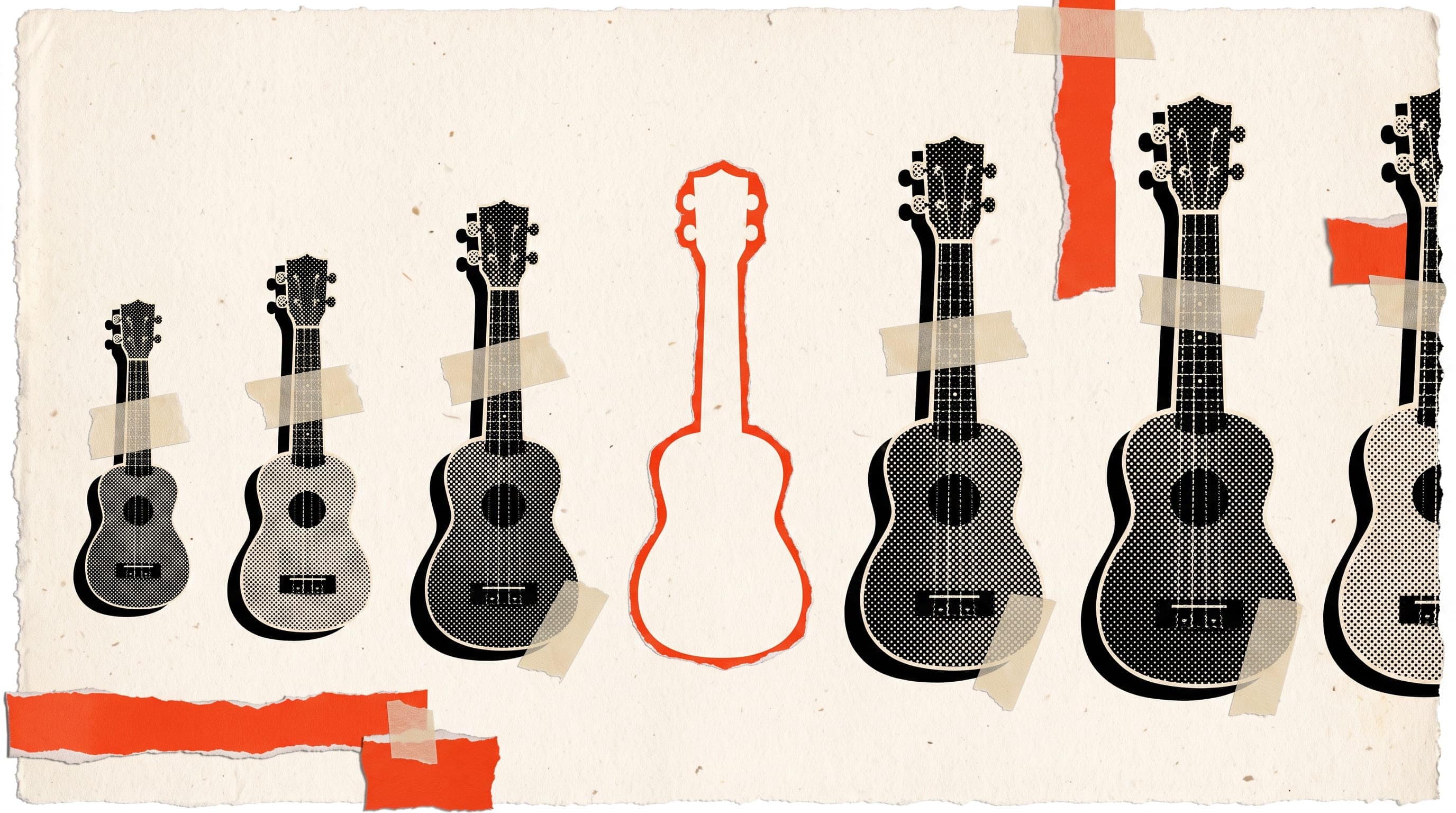
Four strings, a small body and a few chords most adults can play on the first evening. Strung with nylon or similar synthetic strings, the ukulele comes in four main sizes: soprano, concert, tenor and baritone. As the size goes up, the neck gets longer, the frets spread out and the sound fills out. The baritone is not just bigger, it is tuned differently too. Picking your first ukulele mostly means picking between these four.
A very common first week goes like this. You order the smallest, cheapest one. It arrives, you tune it, you strum your first chord, and ten minutes later a string has gone flat. Same thing the next day. It must be faulty, so you start filling in the return form. Most of the time, though, the problem is not the size or the tuning pegs. New strings take a while to stretch, and nobody warns you.
Is the only difference between ukulele sizes how big they are?
The measurement that really separates them is scale length: the vibrating part of the string, from the nut to the saddle. A longer scale means wider fret spacing, a bit more string tension and a fuller sound. The numbers below are approximate and vary slightly between makers.
| Size | Scale length (approx.) | Standard tuning | Sound and feel |
|---|---|---|---|
| Soprano | 13 in / 33 cm | G C E A | The brightest, most "classic" ukulele sound, tight frets |
| Concert | 15 in / 38 cm | G C E A | A little fuller, a little more room on the frets |
| Tenor | 17 in / 43 cm | G C E A | A rounder sound, more space for your fingers |
| Baritone | 19 in / 48 cm | D G B E | Close to a guitar, darker sound |
The first three share a tuning, so they share chord shapes too. A chord you learn on a soprano works the same way on a tenor. The baritone goes its own way.
Which size will feel right for you?
A lot of guides point beginners to the concert size as the balanced option. It keeps most of the soprano's sound but gives adult fingers a bit more room. A few things can tip the decision:
- Big hands: fingers can bump into each other on a soprano's narrow frets. Concert or tenor may feel better.
- Coming from guitar: a tenor is closer to what you are used to in neck length and body.
- Portability: soprano and concert slip into a bag easily, handy for travel or the park.
- That classic uke sound: soprano and concert deliver the bright tone most people picture.
If you can, pick up all three in a shop and play the same chord on each. How your fingers feel will tell you more than any spec sheet.
Why is the G string higher, and what is re-entrant tuning?
Standard ukulele tuning, starting from the string closest to your chin, is G, C, E, A. On a guitar or bass the strings run from low to high. On a ukulele the G is tuned an octave up, so it sits above the C and E. The lowest note actually comes from the C string. This is called re-entrant tuning.
A lot of the ukulele's bright, slightly toy-like charm comes from this. Chords have no low bass note underneath, so everything sits in a close, sparkly range. It matters when you tune, too. Pull the G down an octave and the string goes floppy and dull. Crank it up an octave and it can snap. A tuner only shows you the note name, so check the octave by ear.
Is a baritone ukulele a shortcut for guitar players?
Baritones are usually tuned D, G, B, E, the same as the top four strings of a guitar. If you play guitar, it feels familiar straight away, and the top four strings of your guitar chord shapes carry over.
There is a catch. Almost every ukulele chord chart online is drawn for G C E A. Play one of those shapes on a baritone and you get a different chord. The shape that gives you C on a standard uke gives you G on a baritone. So with a baritone, either read the top four strings of guitar charts or find baritone-specific ones. You can restring it to G C E A, but you will need a dedicated string set.
Which chords get you playing songs in the first week?
On a standard-tuned uke, four chords will get you through a surprising number of pop songs. If chord charts look like code, our guide to reading chords explains the symbols. Strings below are listed G, C, E, A, and the numbers are frets (0 means open):
- C: 0 0 0 3. Just the 3rd fret of the A string.
- Am: 2 0 0 0. Just the 2nd fret of the G string.
- F: 2 0 1 0. 2nd fret on G, 1st fret on E.
- G: 0 2 3 2. The first three-finger chord, and the one that trips most people up.
C and Am needing just one finger each goes a long way to explain why the uke is such a popular first instrument. Nylon strings are also kinder on your fingertips than steel. A bit of soreness in the first days is still normal. Fingertip pain on guitar follows the same pattern, and on a uke it is milder.
Why does a new ukulele keep going out of tune?
Nylon and fluorocarbon strings stretch when they are new. You tune up, the string stretches a little more under tension and the note drops. It is very noticeable in the first days and can last a week or two. Fluorocarbon strings are generally said to settle faster.
To speed things up, tune every time before you play. Gently pulling each string away from the body and letting go speeds it up too, just don't overdo it. Checking the tuning morning and evening for a few days is a quicker fix than sending it back. If the problem is still there after a couple of weeks, then it is worth having the pegs or bridge looked at.
Where does a ukulele fit in a band?
People tend to think of the uke as a solo strumming instrument, but it finds a place in bands too. In an acoustic set it adds a high, bright layer next to the guitar without fighting over the same range. It is also a favourite second instrument for singers: light, not too loud, and able to carry a song with simple chords. When you turn an electric repertoire into an acoustic set, a uke can take some of the load off the guitar.
If the uke needs more low end in a band, that is where a low-G string comes in. The G is tuned an octave down, so the strings run low to high like a small guitar. Notes and chord shapes stay the same, the bottom of the sound just gets thicker, at the cost of some of that signature sparkle. Low-G is not the "pro" option, just a different colour. Most players start with standard tuning and try low-G once they feel they need it.