
How to Build an Acoustic Set from an Electric Repertoire
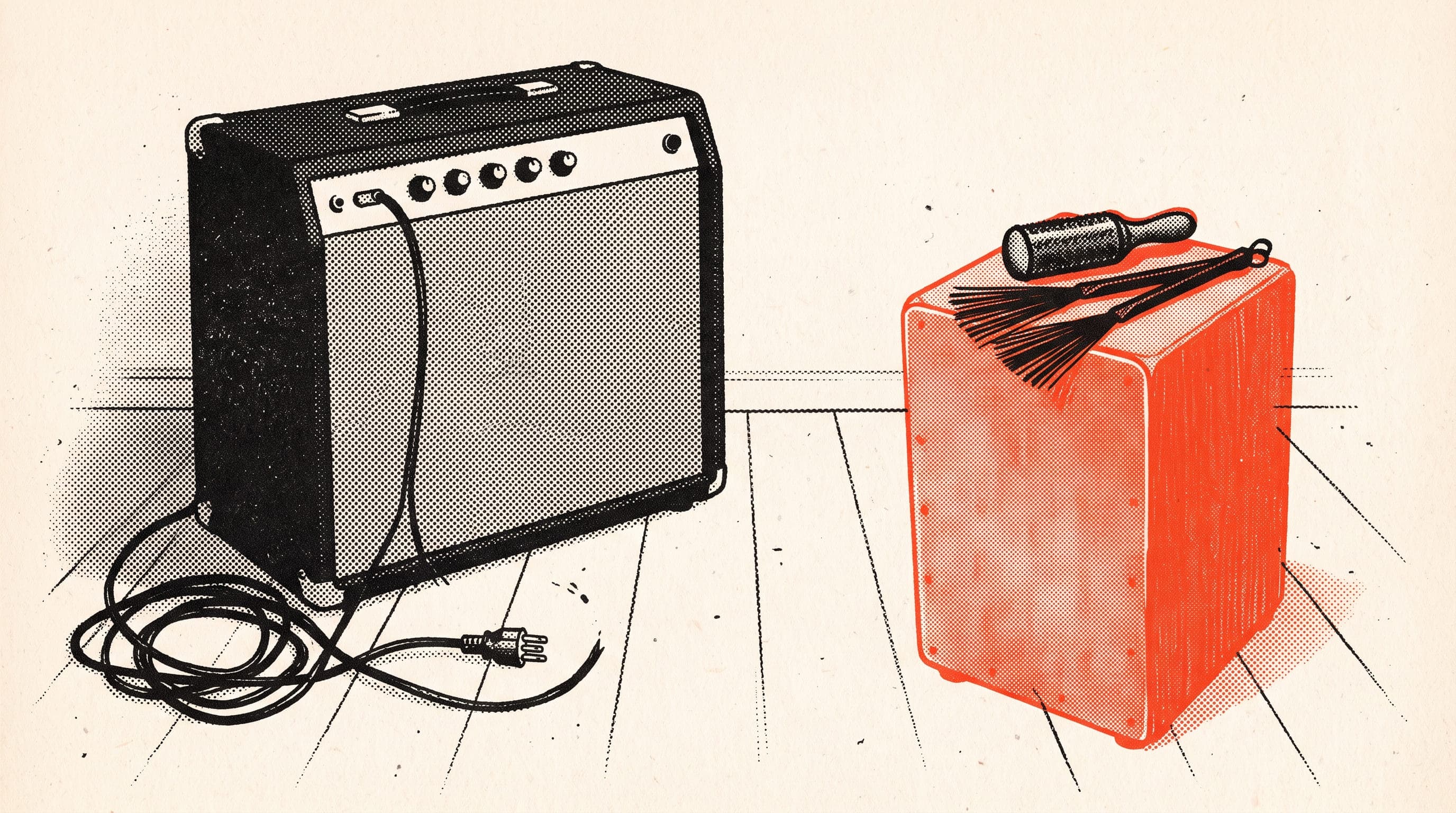
Turning an electric repertoire into an acoustic set isn't just unplugging and playing the same songs. For every song you decide again who steps back, who fills the space, and whether the key still works once the voice is exposed. Here I go through those decisions in order: which songs stay, what replaces drums and bass, key and tempo, sound in a small room, and set order.
The venue texts you: "Can you play acoustic this Saturday? The neighbours are close, no drum kit." Every song you know was rehearsed with distorted guitars and a full kit. Rehearsal is in two days.
Most bands do the same thing the first time. The electric guitar goes, an acoustic comes in. The drummer sits on a cajón. The songs get played exactly as before. What you end up with is a quieter copy of the electric song.
Why doesn't an electric song just work acoustically?
In an electric arrangement, volume fills the gaps. Distorted guitars ring on, a keyboard pad sits in the back like a carpet, cymbals cover every moment. Unplug and the carpet's gone. What's left is chords, melody and lyrics.
So the real job isn't adding things. It's sharing the space again. Who plays the riff? Who lifts the chorus? Where does everyone drop out? In an electric band the answer is often "all of us, all the time." Acoustically that falls apart. Five people strumming at once turns into mush and nobody hears themselves.
Our rule: no more than two instruments up front in any section. Verse is guitar and vocal. The cajón joins for the chorus. Keys take the bridge alone. Everyone else drops out or plays very lightly.
Which songs belong in an acoustic set?
Not every song survives. The simplest test: play it with one guitar and one voice. If the melody and lyrics stand up on their own, it's in. If the song's identity is a sound, a synth hook, a heavy riff, a production trick, you either rethink it or leave it out that night.
Do this test at home before rehearsal. Trying every song on one guitar takes time, but it weeds out the ones that won't work early and leaves rehearsal time for the rest.
| What the song relies on | What happens acoustically | What to do |
|---|---|---|
| Strong melody and lyrics | Carries easily | Keep it, just strip the arrangement |
| Chord-heavy rhythm guitar | Works well on acoustic | Strum less in the verses |
| Distorted riff | Can sound thin when clean | Try it as single notes, an arpeggio or a vocal line |
| Synth hook or production effect | Loses its identity | Try a simple keys version, drop it if it doesn't work |
| Dance track driven by drums | Energy drops | Try cajón and hand claps, maybe move it to the end |
Cover bands have one more test: which version does the crowd know? A stripped-down take on a huge song often lands as a nice surprise. A lesser-known, production-heavy song may not be recognised at all. The criteria you use for choosing cover band songs apply here too.
How do you simplify the groove on cajón?
A cajón is a wooden box you sit on and play with your hands. Hit the middle of the front and you get a deep, round sound that does the kick drum's job. Hits near the top edge are drier and sharper and stand in for the snare. Many cajóns have wires inside that add that snare buzz.
The most common mistake when a drummer moves to cajón is trying to play the kit part as is. There's no hi-hat, no cymbals, no toms. Instead of faking sounds that aren't there, keep the kick and snare skeleton and strip the rest. Add a shaker, brushes or a tambourine where the song wants it.
Dynamics change too. On a kit, the chorus opens up on the cymbals. On cajón you do it by hitting harder and busier. Fingertips in the verse, palm in the chorus already makes a difference.
Bass or no bass?
The centre of the cajón and the bass live in the same frequency range. If both are busy, the low end turns to mud. Simple rule: when one is busy, the other keeps it simple. You've got three options:
- Acoustic bass guitar: Looks right, but it's quiet on its own. Even in a small room it usually needs an amp or the PA.
- Electric bass, played softer: Round off the tone and play fewer notes. This is what we use most, because the bassist stays on their own instrument.
- No bass: The guitar's low strings or the piano's left hand cover the bottom. Common in trios.
If the bassist sits out a song, they can still earn their spot: harmony vocal, tambourine, shaker. In an acoustic set an extra voice often does more than an extra instrument.
Should you change the key or tempo?
Usually a few songs need a new key. In an electric arrangement the singer pushes the high notes through the noise. Acoustically the voice is exposed and those same notes can sound strained. Dropping a half or whole step can make it sound easier and warmer.
A capo is the guitarist's shortcut: same chord shapes, different fret. But a capo on its own only takes you up. To go down you need different chord shapes, with or without a capo, or a lower tuning. A capo chart shows which fret gets you to which key.
There's no fixed rule on tempo. Some songs breathe when you slow them a touch, others drag. Record the slowed-down version at rehearsal and listen back. If it sounds tired, go back to the original tempo.
How do you set up sound in a small venue?
Acoustic sets tend to happen in cafés, bars or the cocktail hour of an event. Lower volume doesn't make things easier. It just changes the problems.
- Feedback: An acoustic guitar's body picks up sound from the speakers and turns it into a howl. Keep the monitor low and run the guitar into the PA through a DI box. If the box has a phase or notch control, try it.
- Cajón: In a small room it carries without a mic. In a bigger space, one mic in front or at the back port is enough.
- Vocal balance: In an acoustic set the vocal sits on top. Set the instruments under the voice, not the other way round.
We change the soundcheck order too: vocal first, then guitar, cajón last. In an acoustic set the voice sets the balance and everything else fits around it.
How do you rehearse an acoustic arrangement?
Rehearsing acoustic like an electric set, running each song top to bottom and moving on, doesn't get you far. We open songs up section by section. First just guitar and vocal play the verse while everyone else listens. Then we decide together who comes in where. Every entry has a reason: so the chorus grows, so the bridge feels different.
Meanwhile everyone asks one question about their part: "What's missing if I don't play here?" If the answer is "nothing," they sit that section out. It feels odd the first time. Nobody's used to standing on stage with idle hands. But play back the recording and you hear the difference right away.
So you don't lose the new arrangement, write the decisions next to the song: who comes in where, which section stays with one instrument, whether the key changed. If you play acoustic less often than electric, an arrangement you forgot in between slides back into old habits on stage.
Run one rehearsal properly quiet, too. Amps down, no kit, everyone actually hearing each other. Timing slips are far more exposed acoustically than with the full band, and this rehearsal brings them out.
How do you order an acoustic set?
You can't lean on volume, so you build energy through the order. We usually go like this:
- Open with a mid-tempo song everyone knows. The crowd warms up and the band gets a feel for the room.
- Slow, lyric-heavy songs in the middle. This is where acoustic works best.
- Put songs with the same capo position or tuning back to back. Fewer gaps.
- Toward the end, songs people clap and sing along to. That's where the cajón hits hardest.
This order doesn't have to match your electric set, and it usually won't. The song that opens your electric show might end up in the middle acoustically.
Two sets means two different lists from the same repertoire. In BandUp you can plan the electric and acoustic setlists side by side in board view and drag songs into order, with total time and song count calculated live. If a song drops a half step for the acoustic show, live transpose in Stage Mode shifts the chords on every band member's screen at once. It's temporary: after the session the song goes back to its original key, so the electric version stays as it was.
We walk through the logic of ordering step by step in our setlist guide, and the same steps apply to an acoustic set.