
Short Neck vs Long Neck Bağlama: Which One to Start With?
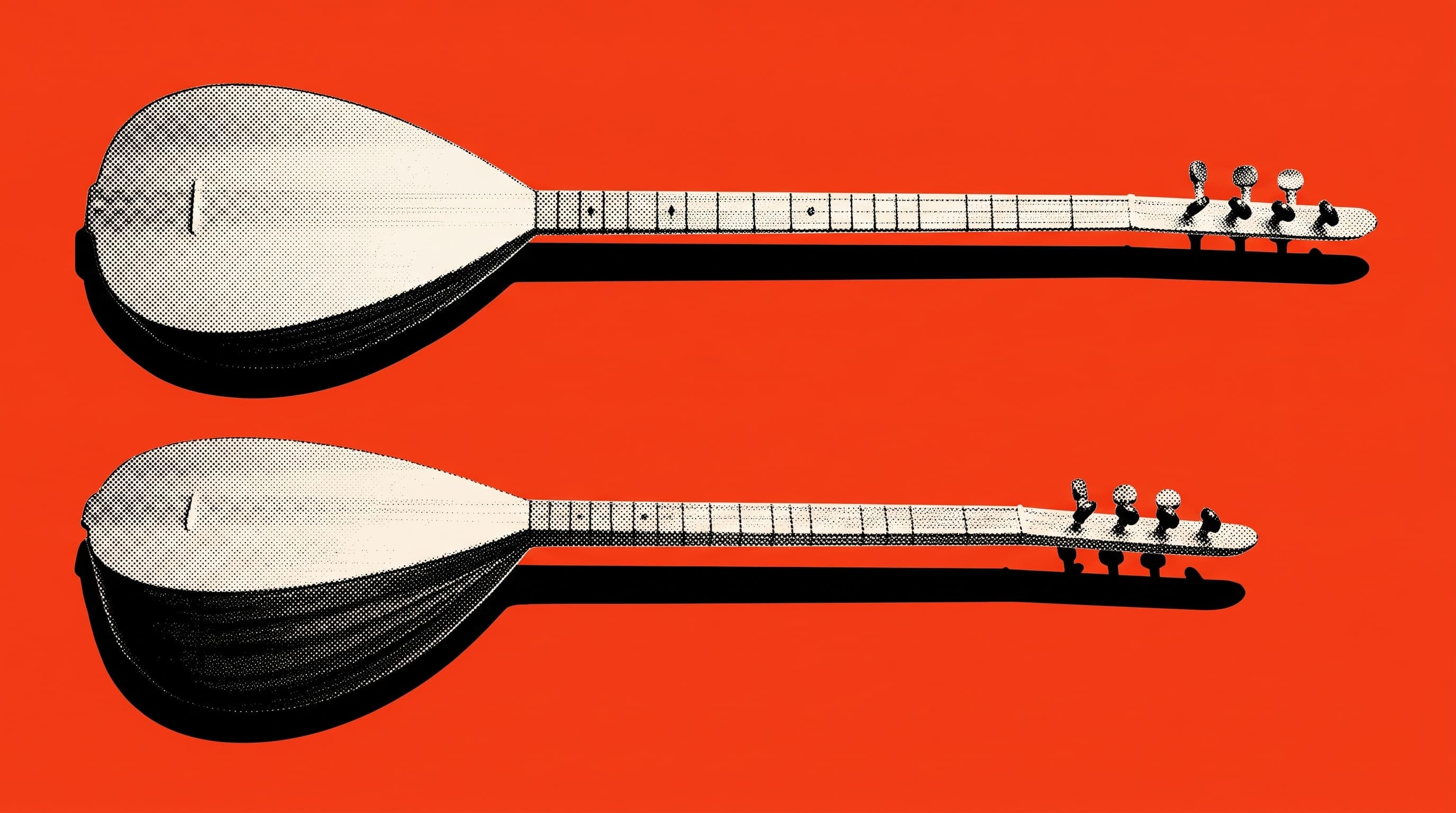
Take a long neck bağlama, cut off its first three frets, and you roughly have a short neck. The bağlama is the long-necked lute at the heart of Turkish folk music, with frets tied onto the neck, and it comes in both sizes. The body and strings are similar. The difference is string length. A shorter neck means a shorter string, frets closer together, a different sound, and often a different tuning.
You're in a music shop. Two instruments hang side by side, both labelled "bağlama". One is clearly longer. The shop assistant asks which one you had in mind, and you don't know what the difference is.
They're two sizes of the same family. Which one you pick depends less on your hand than on the music you want to play.
How long is the string?
A single number would be misleading here, because the sources don't agree. It also varies from maker to maker.
An academic study on bağlama building gets 82 or 84 cm for the long neck, depending on the calculation method, and about 69 cm for the short neck. The Turkish Ministry of Education's course module on the bağlama family uses an 88 cm table for the standard bağlama and works through a short neck example at 64.8 cm. So we're talking roughly 82–88 cm for the long neck and 65–69 cm for the short neck.
Ask the shop for the string length, or measure it yourself: it's the distance between the nut and the bridge.
If the label just says "bağlama", ask outright whether it's a short neck or a long neck. Side by side the difference jumps out, but on its own an instrument may not make it obvious. Ask the same thing on second-hand listings, where the title sometimes just says "saz" or "bağlama".
Short neck and long neck side by side
| Short neck | Long neck | |
|---|---|---|
| String length | About 65–69 cm, depending on source | About 82–88 cm, depending on source |
| Frets | Usually around 19 | Usually around 23 |
| Strings | Mostly 7 (3 low, 2 middle, 2 top courses) | Mostly 7 (3 low, 2 middle, 2 top courses) |
| Common tuning | Bağlama tuning | Bozuk ("kara") tuning |
The fret counts are typical values. The ministry module says a bağlama can have anywhere from 17 to 24 frets and that string length is what decides it. The tuning row isn't a rule either. Both tunings are played on both sizes.
Bağlama tuning and bozuk tuning: on paper vs by ear
In Turkish, a tuning is called a "düzen". It tells you which notes the low, middle and top string groups are tuned to. The ministry module says 19 different düzens have been documented, and the most used are bozuk düzen, also called kara düzen, and bağlama düzeni.
Here's where the confusion comes from: the note names written for a tuning and the pitches the instrument actually plays are often not the same. A string written as "A" in a method book may sound as a different note on your instrument. What matters is the interval between the strings.
| Tuning | Written (low – middle – top) | Suggested pitch on a long neck (as heard) | Suggested pitch on a short neck (as heard) |
|---|---|---|---|
| Bozuk (kara) | A – D – G | C – F – B♭ | F – B♭ – E♭ |
| Bağlama | A – D – E | C – F – G | F – B♭ – C |
The written names come from the ministry module's tuning table. The heard pitches are the general suggestion from Türkü Sitesi, a Turkish folk music site, which itself notes that they change with the player, the instrument and the strings. The same site also writes bağlama tuning as "D – G – A". Same intervals, different starting note.
In practice: if your tuner is set to a different starting note, that's fine, as long as the intervals between the three groups stay the same. If you play in a band, tell the others what pitch you're tuned to, or you won't meet the keyboard player in the same key.
How do you tune it the first time?
Tuning by ear comes with time. The ministry module says so too: it takes experience and a good ear, and for beginners a digital tuner is the more reliable option.
The order goes like this. Tune one of the low strings open, without fretting, to the düzen you've chosen, then bring the other low strings to the same note. Then the middle group, and the top group last. When you're done, fret notes that should match across different groups and play them together. If they don't match, you're not in tune yet.
The module makes one more distinction: setting the fret positions is a one-time job, while the strings get checked before every session. If the frets on a second-hand bağlama have slipped, leave that to a luthier.
Which is easier to start on?
I won't give you a firm answer here, because I couldn't find a neutral source comparing the two. Some teachers and shops recommend starting on the short neck, but it isn't a rule.
My take: on a short neck the frets are closer together and your hand stretches less. Some beginners find that more comfortable. Fret spacing shrinks along with string length; in the ministry module's table, the 5th fret sits 22 cm from the nut on an 88 cm bağlama and 14 cm on a 56 cm cura.
But your hand isn't the deciding factor.
- Who plays the songs you want to learn, and on which instrument? Look at what your favourite players use.
- If you're taking lessons, which size does your teacher teach on? Starting on theirs usually makes life easier.
- Will you play in a band or alone? In a band, where the instrument's range sits in the mix matters too.
Where do the cura, divan and the rest fit in?
The bağlama is a family. From smallest to largest: cura, çöğür, short neck bağlama, long neck bağlama, tambura, divan and meydan saz. The cura is the smallest and is tuned an octave above the long neck. Short and long necks mostly have 7 strings, while a divan has 7 or 9. Across the whole family, the ministry module describes a family running from the three-string cura to the twelve-string meydan saz.
If you're curious how the bağlama ended up in rock bands, read about Anatolian rock.
Is it hard to switch later?
Not impossible, but your hand has to recalibrate. Since the short neck is the long neck minus its first three frets, the same note sits in a different place. The fret spacing changes too, so the distances your fingers have memorised stop working. There's no reliable source on how long the switch takes, so I won't give you one.
Your ear and your sense of rhythm come with you, though. For the 9/8 and other odd meters you'll often meet in Turkish folk songs, what is aksak rhythm helps on either size. And if your first bağlama will be second-hand, here's what to check when buying a used instrument.