
What Is Anatolian Rock? How the Bağlama Met the Electric Guitar
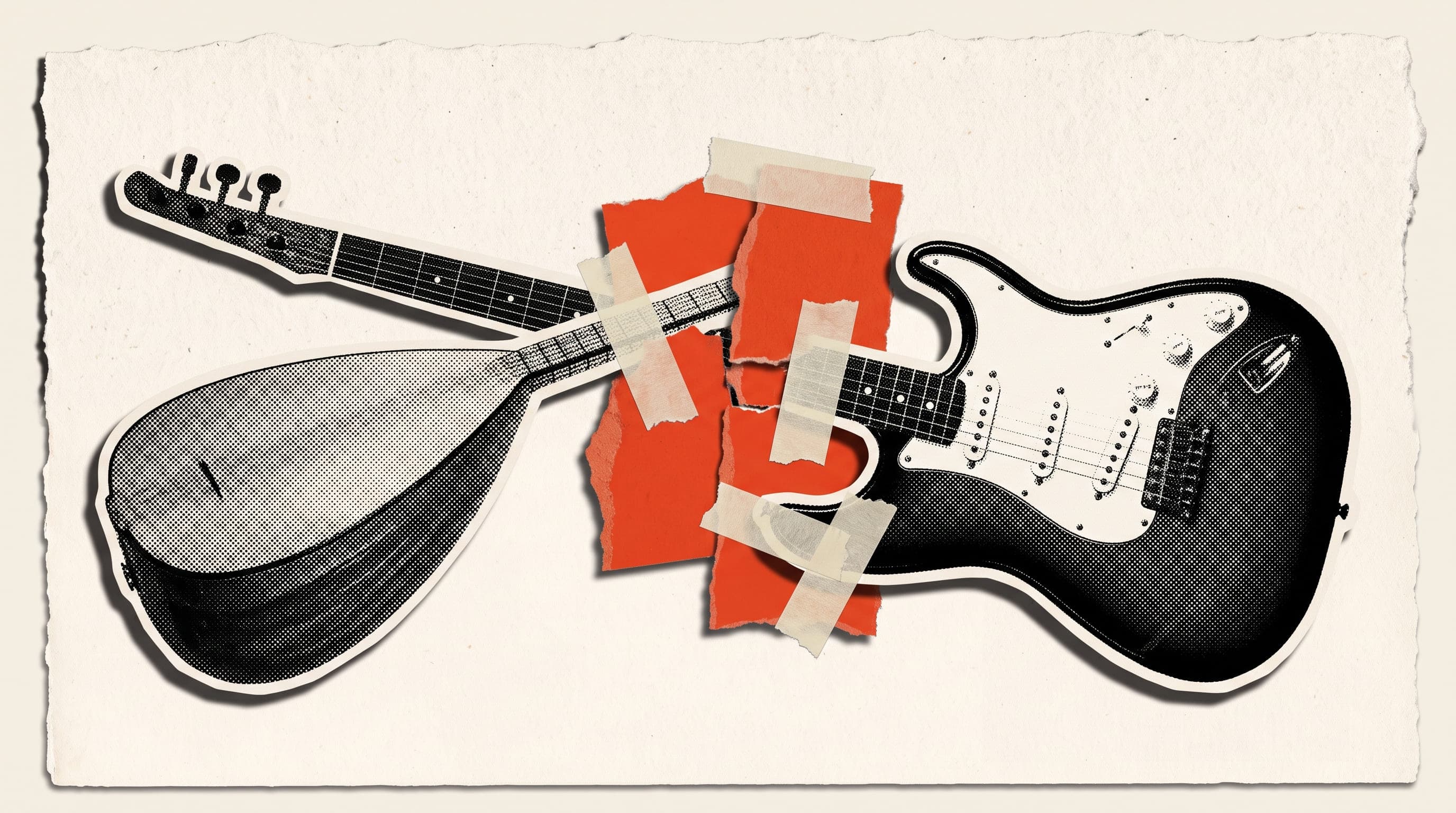
Take a Turkish folk song, play it with electric guitar, bass and drums, without hiding that the melody comes from Anatolia: that's the shortest description of Anatolian rock. The style took shape in the mid-1960s, when rock bands started multiplying in Turkey. Its best-known names are Barış Manço, Cem Karaca, Erkin Koray, Selda Bağcan, Fikret Kızılok and Moğollar.
A message lands in the band chat: "Our bağlama player friend is coming this week. Want to try a rock arrangement of a folk song?" The bağlama is a long-necked Turkish lute, and the first half hour in the rehearsal room usually gets stuck in the same places. The guitarist kicks on the distortion and the bağlama disappears. The drummer can't find where the 9/8 bar turns around. The bassist can't tell which beat to land on. Bands wrestling with that problem sixty years ago left behind a style people still listen to.
Why is it sometimes called "Anatolian pop"?
The style never settled on one name. Moğollar called their first album, released in 1971, "Anadolu Pop" (Anatolian Pop). Today "Anatolian rock" is the more common label, but both names point at the same idea: bringing Anatolian melody together with Western electric instruments.
Sources disagree on who used the term first. The album title is what's certain.
What did the Golden Microphone contest have to do with it?
From 1965 to 1968, the Turkish newspaper Hürriyet ran a yearly music contest called Altın Mikrofon, the Golden Microphone. In the paper's words, the goal was to redirect Turkish music using the technique, style and instruments of Western music. The rules followed from that: contestants had to play Western instruments, and they had to play Turkish music. So a band could walk on stage with electric guitars, but the repertoire had to come from Turkish music.
In 1968, the seven finalist bands, 32 musicians in total, went on a 17-day tour by bus. The contest came back in 1972 with the newspaper Günaydın and again in 1979, but neither drew the attention of the first run.
| Year | First | Second | Third | Note |
|---|---|---|---|---|
| 1965 | Yıldırım Gürses | Mavi Işıklar | Silüetler | Fikret Kızılok competed with Cahit Oben 4, playing "Makaram Sarı Bağlar / Halime" |
| 1966 | Silüetler | Mavi Işıklar | Selçuk Alagöz | |
| 1967 | Mavi Çocuklar | Cem Karaca and Apaşlar | Rana Alagöz | Karaca placed second with "Emrah" |
| 1968 | TPAO Batman | Haramiler | Moğollar | Erkin Koray Dörtlüsü came fourth |
One thing jumps out of that table: most of the names now seen as the style's pioneers never won the contest. But its rules pushed every band that entered toward the same task: playing Turkish music on Western instruments.
Who were the pioneers, and what did each leave behind?
Each came from a different direction:
- Cem Karaca (1945–2004) worked with Apaşlar, Kardaşlar, Moğollar and Dervişan, in that order. With Moğollar he recorded "Namus Belası". After the 1980 military coup he moved to Cologne and returned in 1987.
- Barış Manço (1943–1999) started out with Harmoniler and Kaygısızlar. "Dağlar Dağlar" became a big hit in 1970, and his band Kurtalan Ekspres formed in 1972.
- Erkin Koray had been performing since the late 1950s. The title of his 1974 release "Elektronik Türküler" (Electronic Folk Songs) explains the idea. He died in Toronto on 7 August 2023, aged 82.
- Fikret Kızılok (1946–2001) earned his first gold record with the 1969 recording of "Uzun İnce Bir Yoldayım". His 1977 "Not Defterimden" was an experimental work.
- Moğollar formed in Istanbul at the end of 1967, founded by Aziz Azmet, Murat Ses and Aydın Daruga. In 1971 they won the Grand Prix du Disque from France's Académie Charles Cros. They split in 1976 and got back together in 1993.
Who invented the electric bağlama?
Nobody can say for sure. Both the Turkish and English Wikipedia credit Erkin Koray and Orhan Gencebay with building the electric bağlama together in the late 1960s. The story that often gets told is that Koray fitted a guitar pickup (the part that turns string vibration into an electrical signal) onto Gencebay's bağlama. We couldn't find a primary source for that story, and some sources say the inventor isn't known for certain. The fairest way to put it: the electric bağlama is usually credited to Koray and Gencebay.
The question "what was the first Anatolian rock song?" is in the same boat. Different sources point to different songs and different years, and there's no agreed answer.
The bağlama itself isn't one single instrument, either. The difference between the short-neck and long-neck versions can shape which one works best in a band, and it's broken down in short-neck vs long-neck bağlama.
What makes it recognizable by ear?
We couldn't find a reliable study that describes the sound in measurable terms. What follows is what the ear picks up on recordings from the period.
First, the melody. Most songs come from folk songs, or from melodies written in that spirit. Sometimes the vocal carries the tune, sometimes the electric bağlama, sometimes the guitar. Drums and bass lay down a groove that any rock fan will recognize.
Then there's the rhythm. In Turkish music, rhythms built by placing groups of two and three beats side by side are called aksak. The word means "limping", because to an ear used to counting evenly, the bar seems to stumble at one point. The best-known example is a 9/8 bar counted 2+2+2+3. Fitting that bar together with a rock drummer's straight 4/4 habits is the part of the style that takes the most work. For a step-by-step way to count it, see what is aksak rhythm.
Third, the tone. On the records, both bağlama and guitar come through amplifiers, and on some recordings that sound is clearly distorted. That gives it a very different energy from an acoustic folk recording.
Why are people listening again since the 2010s?
Old records got reissued abroad. The British label Finders Keepers put out Mustafa Özkent's "Gençlik İle Elele" and records by Selda and Ersen in its "Anatolian Invasion" series. That brought them to listeners who don't speak Turkish.
New bands also picked up the sound. Altın Gün formed in Amsterdam in 2016, after bassist Jasper Verhulst posted a call for musicians on Facebook. The band's 2019 album "Gece" was nominated for Best World Music Album at the 62nd Grammy Awards. Gaye Su Akyol, Palmiyeler and Ayyuka are among the other names linked to this line in the 2010s.
How does a band build this sound in rehearsal?
Not a rulebook, just starting steps for moving a folk song into a rock arrangement:
- Count the bar before anyone plays. If the song is in aksak, have everyone clap it out as 2+2+2+3 for a few rounds, and the drums and bass will turn around in the same spot.
- Decide who gets the melody. If the bağlama carries it, give the guitar a riff or a rhythm part. When both play the same line in the same octave, they cover each other up.
- Keep the distortion on the guitar and start low. If the bağlama goes through a mic, it won't be heard unless the stage volume stays down.
- Agree on key and tuning up front. Don't write chord charts until you know which tuning the bağlama player uses and which key sits well for the singer.
- Have everyone listen to the original recording before rehearsal. Intros and breaks on the record teach faster than any explanation.
- No decoration on the first passes. Adding fills (short drum passages between phrases) and solos before the drums and bass lock in is the fastest way for everyone to lose the bar.
If your lineup is still missing a bağlama player or a keyboardist and you're putting the band together from scratch, how to start a band walks through the first steps in order.