
4-String or 5-String Bass? Choosing Your First Bass Guitar
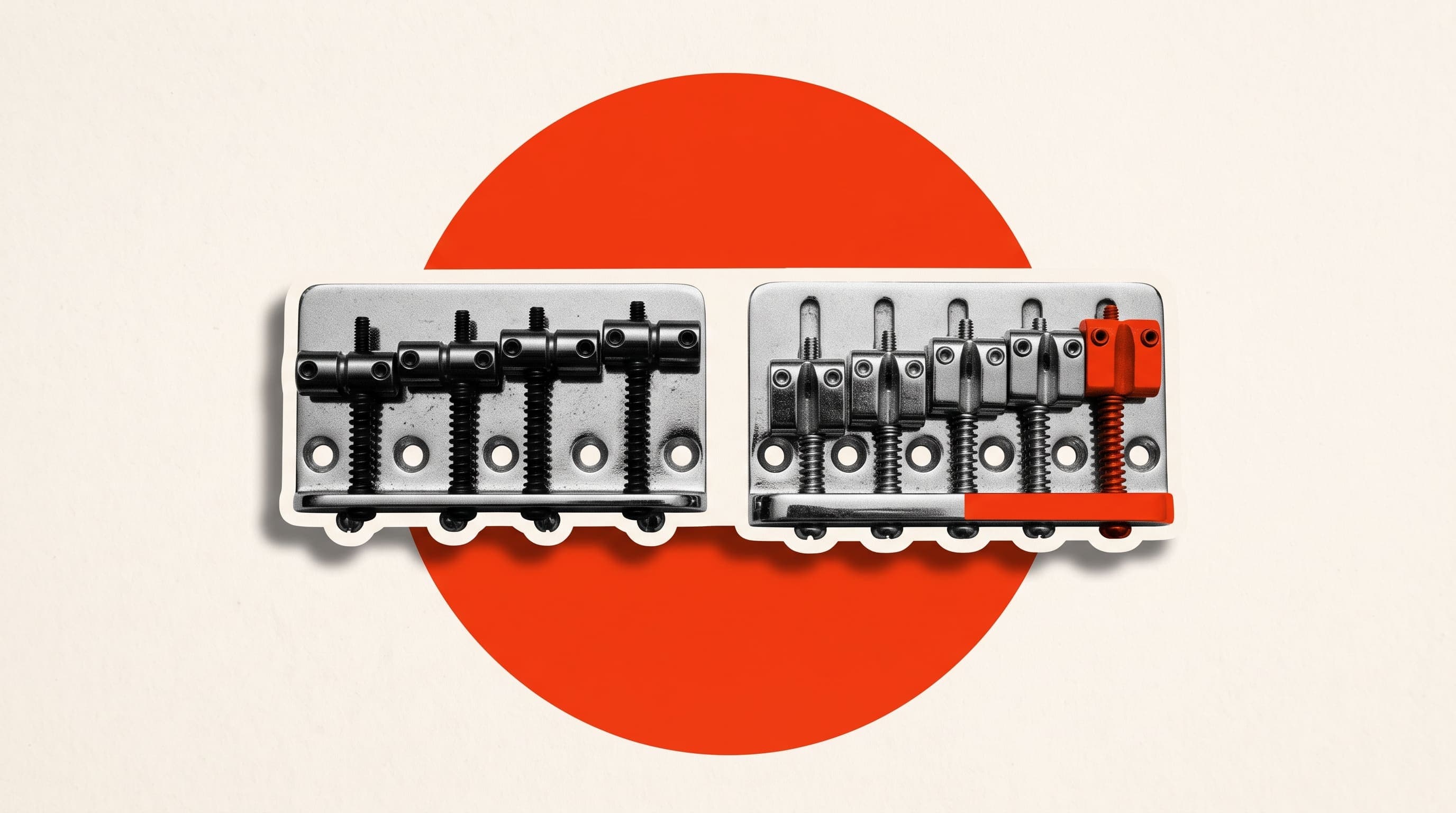
On paper the difference is one string: a 5-string bass adds a thick low B underneath the strings of a regular 4-string. Instead of E, A, D, G you get B, E, A, D, G, and the lowest note drops by a fourth. In your hands, in your ears and in the band's sound, it is a bit more than that.
A new song turns up in drop D. The riff is on the open low string and it is heavy. I want to double it an octave down on bass, but the lowest note on a 4-string is E. No D. Either I play the riff higher up, or I detune mid-rehearsal. That is usually the exact moment the 5-string question comes up.
What does a low B string actually get you?
The obvious gain: five more half steps, a whole fourth, below your open E. On a standard 4-string the open E is about 41 Hz. On a 5-string the open B is about 31 Hz. If you play with guitarists in drop tunings, cover low synth bass parts or back songs that dig into the bottom of the guitar and keys, that range pays off straight away.
The second gain gets talked about less: position. An extra string means covering more range without shifting your hand along the neck. Start a pattern on the B string instead of the E and you reach both the low and middle registers from one hand position. On nights with lots of key changes and quick switches between songs, you feel that.
Living on the low B is not a win, though. Every note down there carries a lot of energy and the mix gets muddy fast. A good low B is a tool you reach for when the song needs it. The real weight still sits in the rhythm you lock in with the drummer, the shared feel we call groove.
How do neck width and string spacing change the feel?
That fifth string has to go somewhere. Makers either widen the neck or tighten the spacing between strings, often a bit of both. The result: a 5-string neck feels thicker and wider. Your fretting-hand thumb travels further round the back, and your wrist opens up more to reach notes on the low string.
There is no rule that says small hands can't play a 5-string. But if this is your first bass and your hands are on the small side, get a few 5-strings in your hands before you buy. Tighter spacing shows up in the plucking hand as well. Fingerstyle, the strings are closer together. Slapping, there is less room for the thumb to hit.
Why does scale length change the way the low B sounds?
The common scale length on a 4-string is 34 inches (about 86 cm). On 5-strings you often see 35 inches (about 89 cm). The reason is the low B. A string that thick needs a certain amount of tension to sound good. On a shorter scale it can feel slack, wobble when you dig in, and come out flabby and undefined.
A 34-inch 5-string is not a bad instrument. String gauge, string construction and setup all play a part, and with good strings and a proper setup you can get a clear low B. If you are looking at a used 5-string, though, the first thing to test is how the B sounds open and on the first few frets. The state of the strings matters a lot here too. A worn B string sounds dull, and the signs that strings need changing are the same on bass.
Why is muting the extra string the first real test?
Most people's first week on a 5-string goes the same way. The B string you are not playing starts humming, from stage vibration or a stray brush of the hand. Muting on four strings has become second nature, and now there is one more to keep quiet.
- Floating thumb: your plucking-hand thumb rests on the string below the one you are playing and moves with you as you change strings, so the lower strings stay muted.
- Fretting-hand fingers: the tip of the fretting finger plays the note, while the flat of the finger lightly touches the strings above to keep them quiet.
- A mute near the nut: some players wrap a light mute or band near the nut. Handy for recording, but don't use it to cover a technique gap.
That is why we tell people moving to a 5-string to think only about muting for the first few rehearsals. The notes are already where they were. The new job is keeping the string you are not playing silent.
What do your music and your band actually need?
A 5-string is not "more pro". The real question is whether your repertoire needs those low notes. Here is a rough map to start from.
| Situation | 4-string | 5-string |
|---|---|---|
| First bass, rock and pop covers | More than enough | Probably overkill |
| Guitarist plays in drop D or lower | You need to retune | Covered in standard tuning |
| Heavy modern metal, low synth bass parts | Limiting | The natural pick |
| Frequent key changes, studio and pit work | More shifting | Less hand movement |
| Slap-heavy funk | Wider spacing | Takes some adjusting |
If your keys player already covers the low end with their left hand, dropping to the low B can make the two instruments collide. In that case, a quick chat at rehearsal about who owns the bottom end can change more than a new string would.
How can you get lower notes on a 4-string?
You can get down there without buying a 5-string. The simplest option is drop D: tune the E string down a whole step to D. That covers the guitarist's drop D song. For lower still, some players tune a 4-string to B, E, A, D. That gives them the bottom four strings of a 5-string but loses the G. It needs a heavier string set and a setup adjustment. An octave pedal adds a note an octave below what you play, which gets a similar effect, but the range under your fingers stays the same.
That is why starting on a 4-string and moving to a 5 when you need it is such a common path. The switch is easier than people expect. The tuning relationships stay the same, there is just one more string at the bottom.
Can the rehearsal room amp handle that low end?
For the low B to really come through, the amp and speaker have to reproduce those frequencies too. A small practice amp or a tired cab in a rehearsal studio can struggle with the B string's fundamental. You end up hearing the note mostly as attack and upper harmonics. Live, the PA can make up for it. At rehearsal, though, you can't hear yourself properly and start digging in harder than you should.
If you rehearse in a studio, ask about the bass amp in advance and play the open B for a few seconds when you arrive. Looking at a used bass? Check the neck and electronics as well as the sound. The checklist for buying a used instrument is ready for that.