
Can You Learn Perfect Pitch? Perfect Pitch vs Relative Pitch
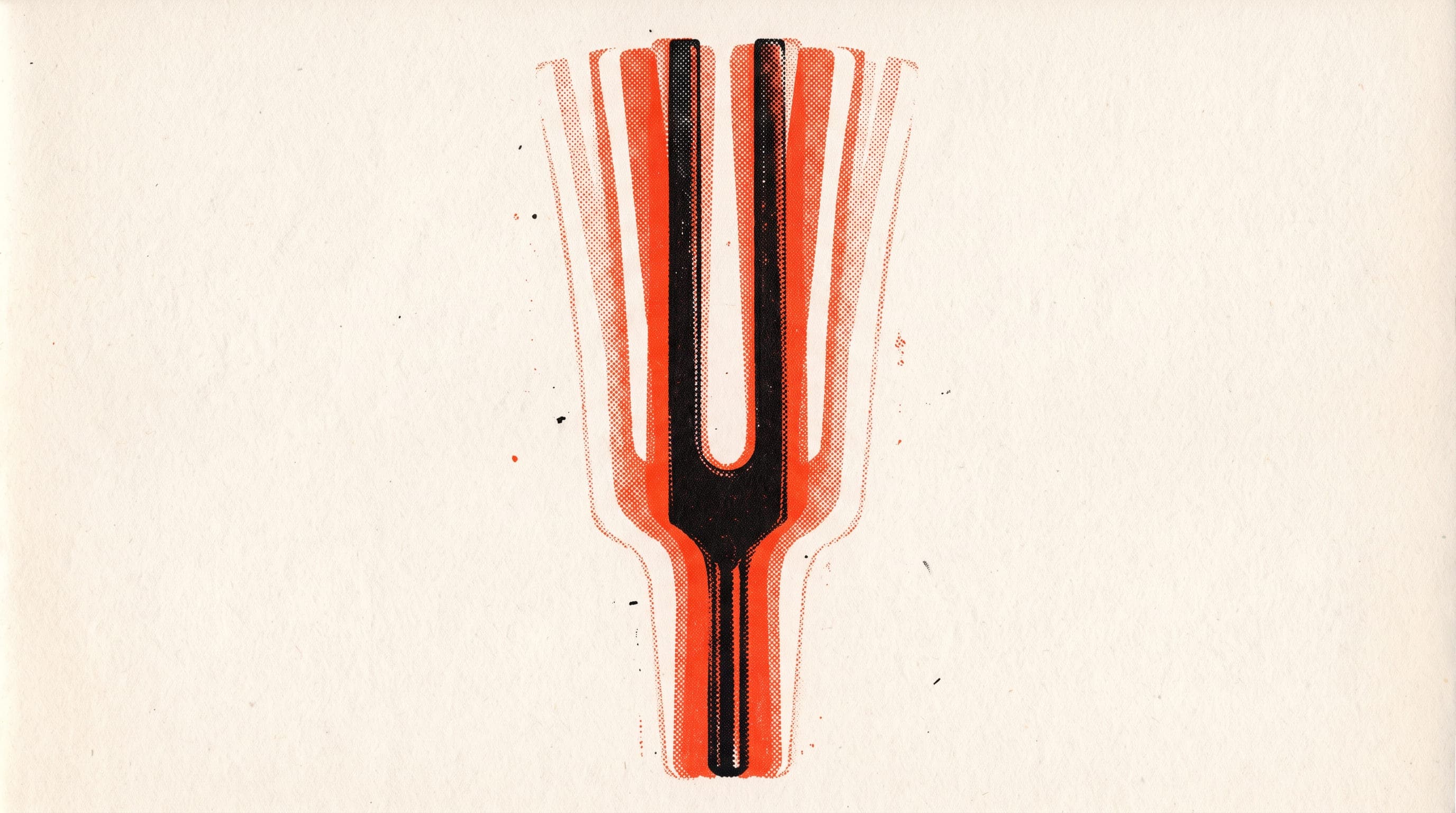
"You either have perfect pitch or you don't." You hear that a lot among musicians, but the research paints a less black-and-white picture. First, the two terms: perfect pitch (also called absolute pitch) is naming or producing a note without hearing any reference note first, while relative pitch is recognising the distance between two notes, the interval.
Someone posts in the band chat: "What key are we doing it in tomorrow, has anyone listened to the recording?" Next day the guitarist hears the first chord, says "D," and everyone turns to look. Maybe he really has perfect pitch. Or maybe he's played that song a hundred times and just remembers the key. From the outside the two look identical, but they're very different skills.
Perfect pitch vs relative pitch
As psychologist Diana Deutsch puts it, people with perfect pitch name notes as quickly and easily as most people name colours. Nobody needs a second colour next to it to say "that's red." Perfect pitch works the same way: no comparison needed.
Relative pitch always has a reference. Hearing the gap between D and F sharp and saying "that's a major third" is relative pitch. According to Deutsch, naming intervals is very common among musicians.
| Perfect pitch | Relative pitch | |
|---|---|---|
| What it does | Names a single note with no reference | Recognises the interval between notes |
| How common | Rare, but the numbers are disputed | Very common among musicians |
| Can you build it later? | Hard for adults, studies show mixed results | Seen as a skill that improves with practice |
| Where it helps a band | Calling the key instantly | Following chord changes, melody and harmony by ear |
Where does "1 in 10,000" come from?
It's the number that always comes up. It's old: studies from 1955 through the 1990s estimated perfect pitch at less than 1 in 10,000 in the general population of North America and Europe.
Not everyone buys it. A 2014 study by Wong and Wong argues that the standard note-naming test keeps underestimating perfect pitch. In their test with violinists, accuracy was 12.38 percent on the standard test and 39 percent on a version that matched how violinists actually work with pitch. The authors argue that prevalence among musicians has been seriously underestimated.
So the figure isn't settled. "1 in 10,000" is a much-repeated estimate, not a measured fact.
How much does early music training matter?
Here the data lines up. In a 1998 survey of more than 600 musicians, 40 percent of those who started training at age 4 or younger reported perfect pitch. Among those who started at 9 or later, it was 3 percent.
The same study adds two caveats. Early training is necessary but not sufficient: plenty of early starters never develop it. And people with perfect pitch were four times more likely to have a family member who has it too. That points to families, but no specific gene has been pinned down yet.
A test with 160 students at the Shanghai Conservatory shows the age effect clearly:
- Started at 5 or younger: 83 percent correct on average (90 percent if semitone errors are allowed)
- Started between 6 and 9: 67 percent (77 percent)
- Started at 10 or older: 23 percent (34 percent)
Why is it more common among tone-language speakers?
In languages like Mandarin, the same syllable means a different word depending on its pitch. In 2006, Deutsch and colleagues compared 88 students at the Central Conservatory in Beijing with 115 students at Eastman, who didn't speak a tone language. At every age of starting lessons, perfect pitch was far more common among the Chinese students. In both groups it was higher for early starters.
A 2009 study looked at 203 students. Among students of East Asian heritage, what mattered was fluency in a tone language, not ethnicity. East Asian students who weren't fluent scored no differently from white students who didn't speak a tone language.
Deutsch's hypothesis is that perfect pitch may depend on a critical period tied to learning speech. It's a hypothesis. The sources don't give a hard cut-off age after which it's impossible. The odds just fall as you get older.
Can adults learn perfect pitch?
Short answer: some can, to a point. Two recent studies tested it directly.
| Study | Participants | Training | Result |
|---|---|---|---|
| Van Hedger, Heald, Nusbaum (2019) | 6 adults aged 18-26, picked for strong auditory memory | 8 weeks, about 32 hours in total | The best learner passed every perfect pitch test and still did 4 months later; most improved only modestly |
| Wong, Lui, Yip, Wong (2020) | 43 adults across three experiments | 12-40 hours, game-based | 6 people (14 percent) named all 12 notes with 90 percent accuracy or better |
Both samples are small. The authors of the 2019 study say adult learning is hard and may only be possible for some people. So "adults can never get it" and "anyone can get it in a few weeks" both clash with the data. If an app promises perfect pitch in a matter of days, keep this table in mind.
Is perfect pitch always an advantage?
Not quite. A few situations get harder:
- Transposed music. In Miyazaki's 2004 study, people with perfect pitch did noticeably worse at comparing transposed melodies, both against the original versions and against people without perfect pitch. Deutsch also acknowledges that music played in a different key from the score can feel uncomfortable.
- Drift with age. From their 40s or 50s, some people with perfect pitch start hearing notes slightly sharp or flat. In one case Deutsch cites, a person heard notes a semitone sharp at 40 and three semitones sharp at 71. Others never drift, and nobody knows why.
- Transposing instruments. Children who start on instruments where the written note and the sounding note differ, like the B-flat clarinet or the French horn in F, may be at a disadvantage.
Then again, the idea that perfect pitch ruins relative pitch is disputed too. In a 2011 study by Dooley and Deutsch, people with perfect pitch did better on standard interval-naming tasks. If someone in your band struggles every time you move a song to a new key, it helps to talk through how transposing works together.
How do you build relative pitch?
Good news: most of a band's everyday work runs on relative pitch. We haven't verified any data comparing which method works best, so treat these as common musician habits rather than proven rankings.
- Match each interval to the first two notes of a song you know. Pick your own song for each one.
- Hear a short melody, sing it back, then play it on your instrument.
- Learn to tell major chords from minor ones, then add sevenths.
- Work out the bass lines of songs you like by ear. The bass shows chord changes more clearly than any other part.
- If you sing, get to know your own range. Finding your vocal range shows which notes you reach comfortably.
One more finding worth knowing: people without perfect pitch can still tell, better than chance, whether a well-known song or TV theme has been shifted up or down by a semitone or two. Your ear remembers keys better than you think, and you'll notice it more once you start recognising how chords line up in songs. The most common chord progressions are a good place to start.