
Common Chord Progressions: The Chord Patterns Behind Most Songs
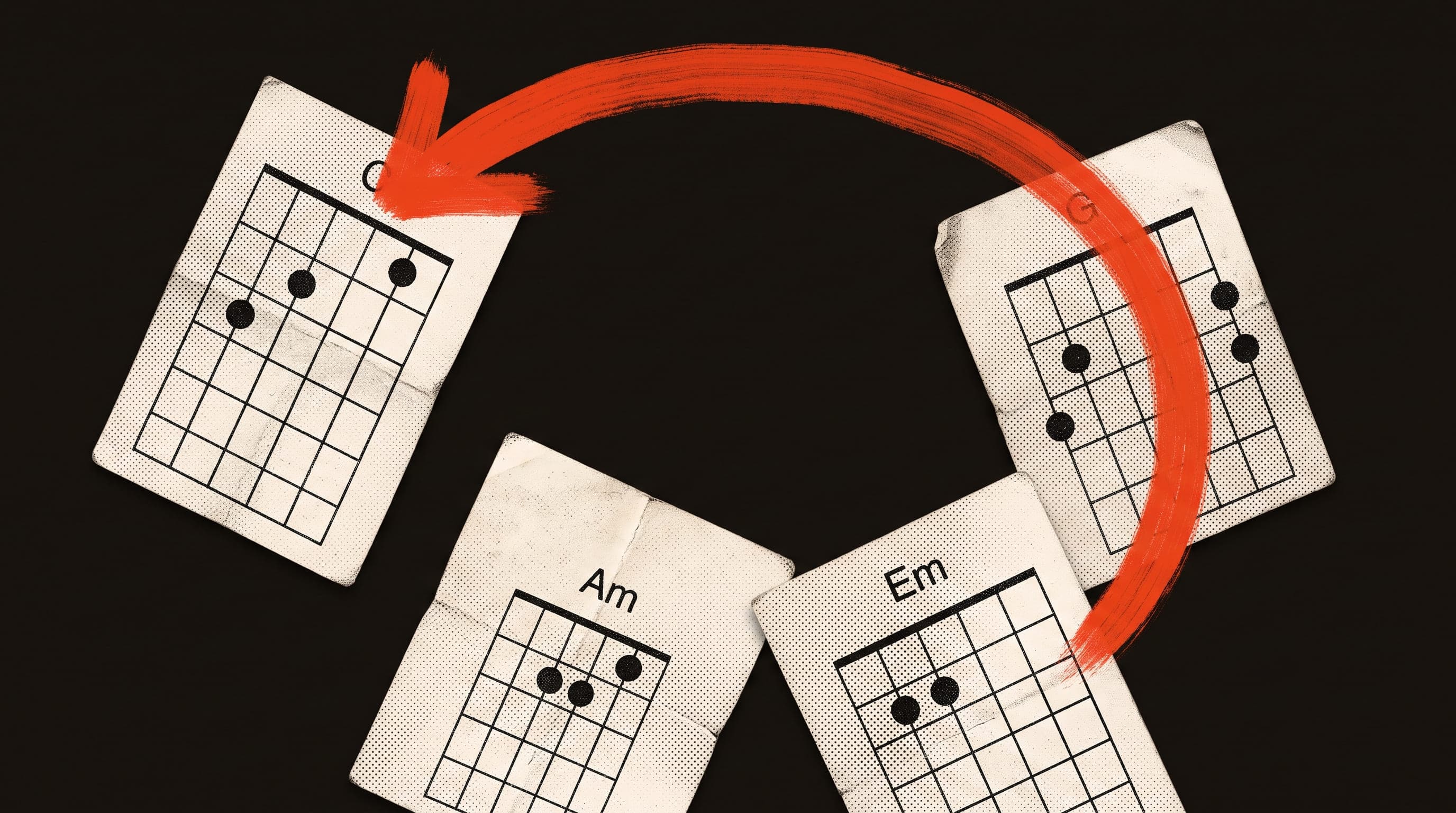
Someone puts on a new song at rehearsal and before the chorus even hits you're thinking "I know these four chords." What you know isn't the song. It's the chord progression: the sequence of chords that cycles behind it, usually on repeat. Countless songs sit on the same handful of progressions, so once you know a few, new songs come together a lot faster.
The keys player says "it's in C," the guitarist has a capo on and is playing G shapes, the bassist is going by ear. All three are playing the same progression and seeing three different sets of chord names. Rehearsals got quicker for us the day we started talking about the progression instead of the chord names.
Roman numerals: where the chord sits, not what it's called
Roman numerals are the shared language for this. The numeral tells you which step of the key the chord's root is on. Upper case means a major chord, lower case a minor one. In C major, C is the first degree (I), F the fourth (IV), G the fifth (V), Am the sixth (vi).
The nice part: because numerals follow the scale step and not the note name, the progression stays the same when the key changes. "I–V–vi–IV" is C–G–Am–F in C and D–A–Bm–G in D. If chord symbols still slow you down, start with how to read chords and the table below will be easier to use.
Every step of a major key has its own chord: I, ii, iii, IV, V, vi and vii°. The major chords sit on I, IV and V, the minor ones on ii, iii and vi. The seventh step is diminished, which is what the ° means. In C major that gives you C, Dm, Em, F, G, Am, B°. To find a chord's numeral, just count up the scale. C, D, E, F: F is fourth, so it's IV.
In pop, the four chords you'll meet most are I, IV, V and vi. Most of the progressions below are those four in a different order.
Ready-made table in six keys
| Progression | C | G | D | A | E | F |
|---|---|---|---|---|---|---|
| I–V–vi–IV | C–G–Am–F | G–D–Em–C | D–A–Bm–G | A–E–F#m–D | E–B–C#m–A | F–C–Dm–B♭ |
| vi–IV–I–V | Am–F–C–G | Em–C–G–D | Bm–G–D–A | F#m–D–A–E | C#m–A–E–B | Dm–B♭–F–C |
| I–vi–IV–V | C–Am–F–G | G–Em–C–D | D–Bm–G–A | A–F#m–D–E | E–C#m–A–B | F–Dm–B♭–C |
| IV–V–vi–I | F–G–Am–C | C–D–Em–G | G–A–Bm–D | D–E–F#m–A | A–B–C#m–E | B♭–C–Dm–F |
| I–IV–V | C–F–G | G–C–D | D–G–A | A–D–E | E–A–B | F–B♭–C |
| ii–V–I | Dm7–G7–Cmaj7 | Am7–D7–Gmaj7 | Em7–A7–Dmaj7 | Bm7–E7–Amaj7 | F#m7–B7–Emaj7 | Gm7–C7–Fmaj7 |
If barre chords like B♭ or F#m are a pain on guitar, a capo sorts it: clip it on and play the shapes of an easier key, and the progression stays the same. The maths is in the capo guide.
Same four chords, four different starting points
I–V–vi–IV and vi–IV–I–V are the same four chords. The only difference is where you start. But the starting point changes how the song feels.
Open Music Theory calls this family the "singer/songwriter" schema and says it took off from the mid-1990s with singer-songwriters like Sarah McLachlan, Jewel and Joan Osborne. Start on the minor chord and your ear can't decide for a while whether the song is major or minor. The best-known example is "Despacito": Bm–G–D–A. You can hear it as vi–IV–I–V in D major or as i–VI–III–VII in B minor. Heart's "What About Love" uses that ambiguity to move from a minor-sounding intro to a major chorus. The chorus of Lady Gaga's "Alejandro" runs IV–I–V–vi, yet another rotation of the same four.
There's a practical side to this in rehearsal. One person says "it's in A minor," another says "no, it's C major." Both are playing the right chords. Settle it with the numbers, not the chord names.
The 50s progression: I–vi–IV–V
Also called the doo-wop progression, after the rock ballads of the 1950s and early 60s. In C it's C–Am–F–G.
Examples from Open Music Theory:
- Gene Chandler, "Duke of Earl" (1962)
- Bonnie Tyler, "Total Eclipse of the Heart" (1983), the chorus
- Rebecca Black, "Friday" (2011)
- Bruce Springsteen, "Hungry Heart" (1980): the variant with ii in place of IV, I–vi–ii–V
- Coldplay, "Viva la Vida" (2008): a rotation, IV–V–I–vi
Hopscotch: IV–V–vi–I
A newer family. Open Music Theory says it's been common since 2010, with examples like Sam Smith's "Dancing with a Stranger" (2019) and "No Brainer" (2018) by DJ Khaled, Justin Bieber and Quavo. The tell is at the end: the progression leaps from vi straight to I.
I–IV–V and moves with blues roots
The three-chord I–IV–V is as basic as it gets. Its best-known home is the 12-bar blues, which I go through bar by bar in the 12-bar blues guide.
In blues-based progressions the move from IV back to I, the plagal move, is front and centre. A few examples:
- A two-chord I–IV vamp, everywhere in R&B and soul: Sam & Dave's "Soul Man" (1967), Wilson Pickett's "In the Midnight Hour" (1965).
- IV–iv–I: the fourth chord played major, then minor, then home. Green Day's "Wake Me Up When September Ends" (2005).
- ♭VII–IV–I: the coda of the Beatles' "Hey Jude" (1968). In C that's B♭–F–C.
ii–V–I: how jazz standards close
This is the core progression of traditional jazz. In major it's ii7–V7–Imaj7, so Dm7–G7–Cmaj7 in C. The roots drop by fifths: D, G, C. "Afternoon in Paris," "All the Things You Are," "My Funny Valentine" and "Joy Spring" all use it for their final cadence.
There's also a turnaround version: I–vi–ii–V–I, played at the end of a section to get back to the top. Notice how close it is to the 50s progression. The only change is ii in place of IV.
The Andalusian cadence: walking down in minor
What most players know as the Andalusian cadence goes i–♭VII–♭VI–V. In A minor that's Am–G–F–E. The bass walks down through four notes, from the tonic to the dominant. Open Music Theory covers it as the "lament" schema: the same descent sits under Baroque laments like Purcell's "Dido's Lament." On the rock side, it points to Dire Straits' "Sultans of Swing" (1978) and Muse's "Thoughts of a Dying Atheist" (2004).
In the common minor keys:
- A minor: Am–G–F–E
- E minor: Em–D–C–B
- D minor: Dm–C–B♭–A
- B minor: Bm–A–G–F#
The last chord is major, not minor. You're in a minor key, but V is played major, and that's where the pull back to the top comes from.
How do you spot a progression by ear?
The most useful clue is which chord leads into the tonic. Open Music Theory uses it to tell the four-chord schemas apart:
- If I arrives from V, it's probably the 50s progression.
- If it arrives from IV, it's the singer/songwriter family.
- If it jumps in from vi, it's hopscotch.
What I do in rehearsal is simpler. I listen to the bass line first, because it gives you the roots most clearly. Then I find the chord that feels like home and count the others from there. One, four, five, six. By the fourth time round you don't need to write it down.
One more habit: write the numbers next to the chord names on your chart. When the singer says "let's drop it a half step," every chord name changes but the numbers stay put. If I–V–vi–IV is in your head, you only need to find the new I, and everything else sits at the same distance. When the whole band talks in numbers, a key change stops turning into a five-minute maths session mid-rehearsal.