
Why Won't My Barre Chords Ring Clean? How to Play F
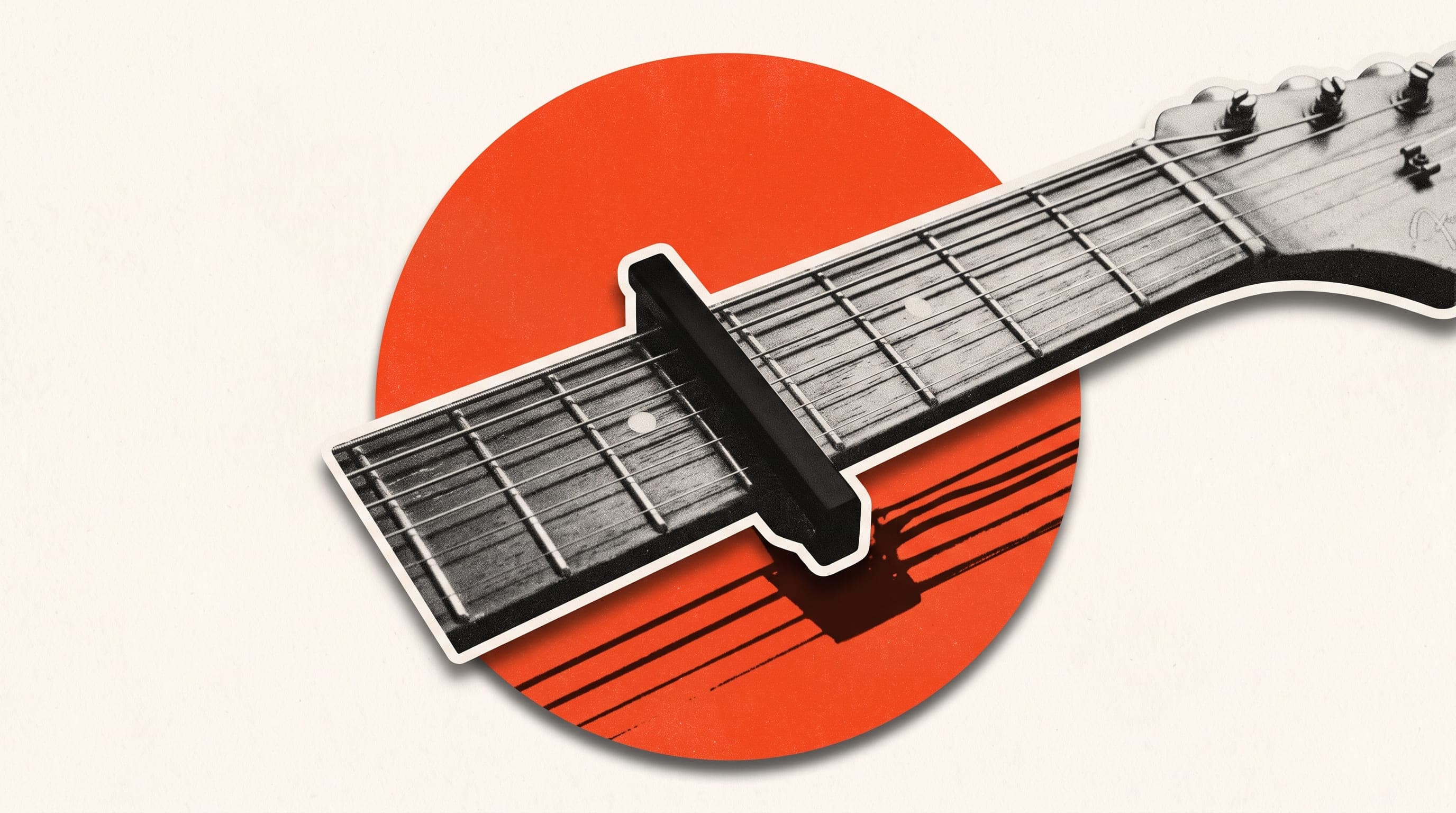
Lay your index finger flat across all six strings like a bar and press them all at the same fret, and you're playing a barre. The finger works like a capo, and your other fingers build a chord shape in front of it. The full F chord is exactly that, a barre at the 1st fret.
The song is rolling, F comes up, and your hand stops. By the time your fingers land, the groove is gone. You strum and one string is muted, another isn't there at all. You press again, harder. Nothing changes.
Pressing harder isn't the answer. First you need to find out which string is dying and why.
What makes F so hard?
Two things stack up. One finger has to hold down six strings. And F sits at the fret closest to the headstock. Fender says getting a clean sound there takes a lot of pressure, and that's what most beginners complain about.
So it's not just you. Barre chords are widely seen as one of the hardest stages in learning guitar.
Which string is dead?
Fret the chord and pick the strings one by one, from the low E to the high E. Don't strum them all. The moment you hear which one is muted, you're halfway there.
| What you hear | Likely cause | What to try |
|---|---|---|
| The B or G string is muted | A crease or the soft pad of your index finger lands on that string | Slide the finger slightly up or down, roll it a little toward its bony edge |
| One of the middle strings is missing | Another finger is lying flat and touching the string below it | Arch that finger and come down on the tip |
| Every string buzzes a little | The barre finger is too far from the fret wire | Move it right up behind the fret |
| Everything's hard at the 1st fret, the same shape is easy at the 5th | The action or the nut may be high | Have a music store or tech measure it |
| The chord rings but sounds slightly out of tune | A high nut stretches the string as you press, which can push the note sharp | Check the fretted notes with a tuner, get it adjusted if needed |
| Your wrist hurts | Thumb or elbow in the wrong place, squeezing too hard | Stop, reset your position, try again |
Where exactly should the index finger go?
Right behind the fret wire. The further back you drift into the middle of the fret, the harder you have to press for the same clean sound. Close to the fret, you get away with the least pressure.
Press with the bony edge that faces your thumb, not the soft underside. Rolling the finger slightly to the side does this for you. If a knuckle crease lands on a string, shift the finger a few millimetres so the crease sits in the gap between strings.
An order that works for me: place your middle, ring and pinky first, and lay the barre down last. The shape fingers find their spots, and the index finger settles in behind them. After a while, everything lands at once.
Where do the thumb and elbow go?
Keep your thumb on the back of the neck, roughly behind your index and middle fingers. If it creeps over the top, you can't push against the barre.
Keep your elbow close to your body. Swing the arm out and the wrist bends, the effort starts coming from the wrist, and that's what gets tired.
Something I see a lot in rehearsals: F comes up and the whole hand tenses. Thumb clamps the neck, shoulder rises. Still muted.
Why doesn't pressing harder work?
Because the problem is placement, not strength. If a crease sits on a string, that string stays muted however hard you squeeze. Brute force just tires the hand and hurts your fingertips.
Try this: fret the chord, then slowly ease off. Just above the point where notes start to break up is all the pressure you need. Usually less than you think.
Could the guitar be the problem?
It could. Fender says barre chords are harder on a guitar with high action, since one finger has to push all six strings down. A setup fixes that.
At the 1st fret the nut comes into play too, the piece at the headstock end the strings run over. If the nut slots are cut too high, the string is hard to push down and can go sharp. The numbers vary by maker. Taylor gives its factory nut height, measured from the top of the 1st fret to the bottom of the string, as about 0.61 mm on the low E and about 0.48 mm on the B and high E. MusicNomad, which makes guitar care products, suggests about 0.50 mm for the low strings and 0.40 mm for the high ones. The two don't match, which is why having a tech measure your own guitar is the safest bet.
Quick test: play the same barre shape at the 5th fret. If it's comfortable there and impossible at the 1st, a setup issue is likely.
What are the steps up to a full F?
Fender's approach is to build the chord in pieces instead of jumping straight to the full barre. Honestly, it's the least painful order:
- Three-note F. Index on the 1st fret of the B string, middle on the 2nd fret of the G string, ring on the 3rd fret of the D string. Play only the D, G and B strings.
- Mini barre. Same shape, but your index finger holds both the B and high E strings at the 1st fret. Play four strings down from the D string.
- Full barre. Index across all six strings at the 1st fret, middle on the 2nd fret of the G string, ring on the 3rd fret of the A string, pinky on the 3rd fret of the D string. Strum all six.
- F at the 8th fret. Index on the A string and high E string at the 8th fret, middle, ring and pinky on the 10th fret of the D, G and B strings. Play five strings down from the A string.
Two more ideas. Fender suggests trying your first full barre on an electric if you can, since the strings are usually lighter. Some teachers also suggest starting the barre between the 5th and 12th frets, where the strings feel slacker, and gradually moving the shape down.
Once F rings clean on its own, work on the change. Fender's next step is switching between F and Bb, another barre chord.
In rehearsal, if F shows up mid-song, start moving your hand a bar early. For the first few weeks, giving up one beat on the way to F beats playing it muted. The band carries the groove while you catch up. A few rehearsals later, you won't need that beat.
When should you take a break?
Right away if your wrist hurts. Fender is clear on this: if you get wrist pain, stop. Sore fingertips in the first weeks are a different story; here's how guitar fingertip pain works.
You don't have to wait for F to play the song, either. With a capo you can play it using shapes that don't need a barre, and how to use a capo shows which shape goes with which fret. If chord charts still slow you down, start with how to read chords.