
Digital Piano or Synthesizer? How to Choose Your First Keyboard
Line up three keyboards in a music shop and they look almost the same: a black body, black and white keys. But one is built to copy the sound and feel of a piano, one is built to create sounds from scratch, and one is built to play a whole backing band with rhythms and auto accompaniment. Choosing between a digital piano and a synthesizer really comes down to what you are going to sit down and play.
Say someone wants to start piano lessons and finds a cheap keyboard online with hundreds of sounds and light, springy keys. A few months in, their teacher asks them to "dig into the keys a bit more", and there is nothing to dig into. Meanwhile a band down the road is looking for a keys player to cover organ and pads in a rock set, and the one candidate turns up with a heavy digital piano that only does piano. Neither instrument is bad. Each was bought for the wrong job.
What does each type of keyboard actually do?
There are five main types, each with a different job. What you plan to play most should decide where the money goes.
| Type | Main job | Key feel | Who it suits |
|---|---|---|---|
| Digital piano | Recreate the sound and touch of an acoustic piano | Usually weighted | Anyone learning piano at home, classical or pop |
| Stage piano | A digital piano built to travel | Usually weighted | Band players covering piano and electric piano |
| Synthesizer | Build and shape sounds from scratch | Usually light | Players working with pads, leads and sound design |
| Arranger keyboard | Play full songs alone with rhythms and accompaniment | Usually light | Solo entertainers, function and wedding players |
| MIDI controller | No sounds of its own, it triggers software on a computer | Varies by model | Home recording and anyone using software instruments |
Note the word "usually". Weighted synths and light-action digital pianos both exist, so check the key action line on the spec sheet, not the category name.
One more note on stage pianos: most of them have no built-in speakers. They plug into an amp, a PA or headphones. Check this before you buy.
Why is key action the biggest decision?
Weighted or hammer action keys copy the resistance of the hammer mechanism in an acoustic piano, so the low keys feel a little heavier than the high ones. Semi-weighted keys are sprung but still push back a bit. Synth action keys are light and spring back fast. Great for organ, synth and fast repeated parts.
If you are learning piano, key feel matters even more than the sound. Playing a note softly or hard, which is what dynamics come down to, develops on weighted keys. Years on light keys can make a real piano feel heavy and tiring, while going the other way is easy. If you are starting from sheet music, our guide to reading sheet music is a good companion for the first few weeks.
If your band role is mostly pads, organ and synth sounds, light or semi-weighted keys will do the job. If the set has piano parts too, go semi-weighted or a weighted stage piano.
61, 76 or 88 keys: how many do you need?
88 keys is the full range of an acoustic piano, from the lowest A to the highest C, a bit more than seven octaves. 61 keys gives you five octaves. 76 keys sits in between and is common on stage keyboards.
- 88 keys: if you want to work on piano repertoire. A lot of classical pieces go beyond what 61 keys can reach.
- 76 keys: for a band keys player who covers piano parts but hauls the instrument to every gig.
- 61 keys: for synth, organ and pads, for a small desk, or for use as a MIDI controller when recording.
Don't mix up the number of keys with how they feel. 88 light keys are no more "piano" than 61 weighted ones. Decide on the action first, then the size.
What does the polyphony number tell you, and what doesn't it?
Polyphony is how many notes a keyboard can sound at the same time. But when you hold the sustain pedal, earlier notes keep ringing. Layer two sounds, like strings under a piano, and every key uses two notes. Once the limit is hit, the oldest notes cut out abruptly.
For basic playing, 64 notes is usually enough and 128 is comfortable. Anything above that does nothing for the key feel or the sound quality. A big polyphony number on a shop tag tells you far less than pressing a few keys and listening.
What should a band keyboard player look for?
A keyboard you play alone at home and one that sits in a band need different things. In a pop or rock set the keys player might jump between piano, electric piano, organ and pads in one night. A short checklist:
- Switching sounds: changing sounds with one button between songs. Keyboards that let you save sounds in order make working through a setlist much easier.
- Outputs: separate left and right outputs for the PA. The sound engineer will usually take them through a DI box.
- Weight: this thing is going to every rehearsal and gig. 88 weighted keys make themselves known on the stairs.
- Built-in speakers: handy at home, rarely used on stage, where you need a PA or a keyboard amp.
- Stand and case: not included in the price, but needed before the first gig.
Arranger keyboards are very common in Turkey, especially in wedding and party music. The rhythm and accompaniment section earns its keep when one person is carrying a whole band's worth of sound. In a full band those rhythms clash with the drums and bass, so the sounds are what matter.
Does it make sense to start with a MIDI controller and a laptop?
A MIDI controller makes no sound on its own. When you press a key, it tells your computer or tablet which note you played and how hard, and software there makes the sound.
If you want to record at home, or you are not sure yet which sounds you will end up playing, it is a sensible way in. If you already have a DAW, the software you record music in, the sounds are right there. The downside: every session means booting up the computer, plugging in headphones and sorting out the delay between pressing a key and hearing it. When you only want five minutes at the keys, that can be enough to put you off.
Why do you need a proper pedal and headphones from day one?
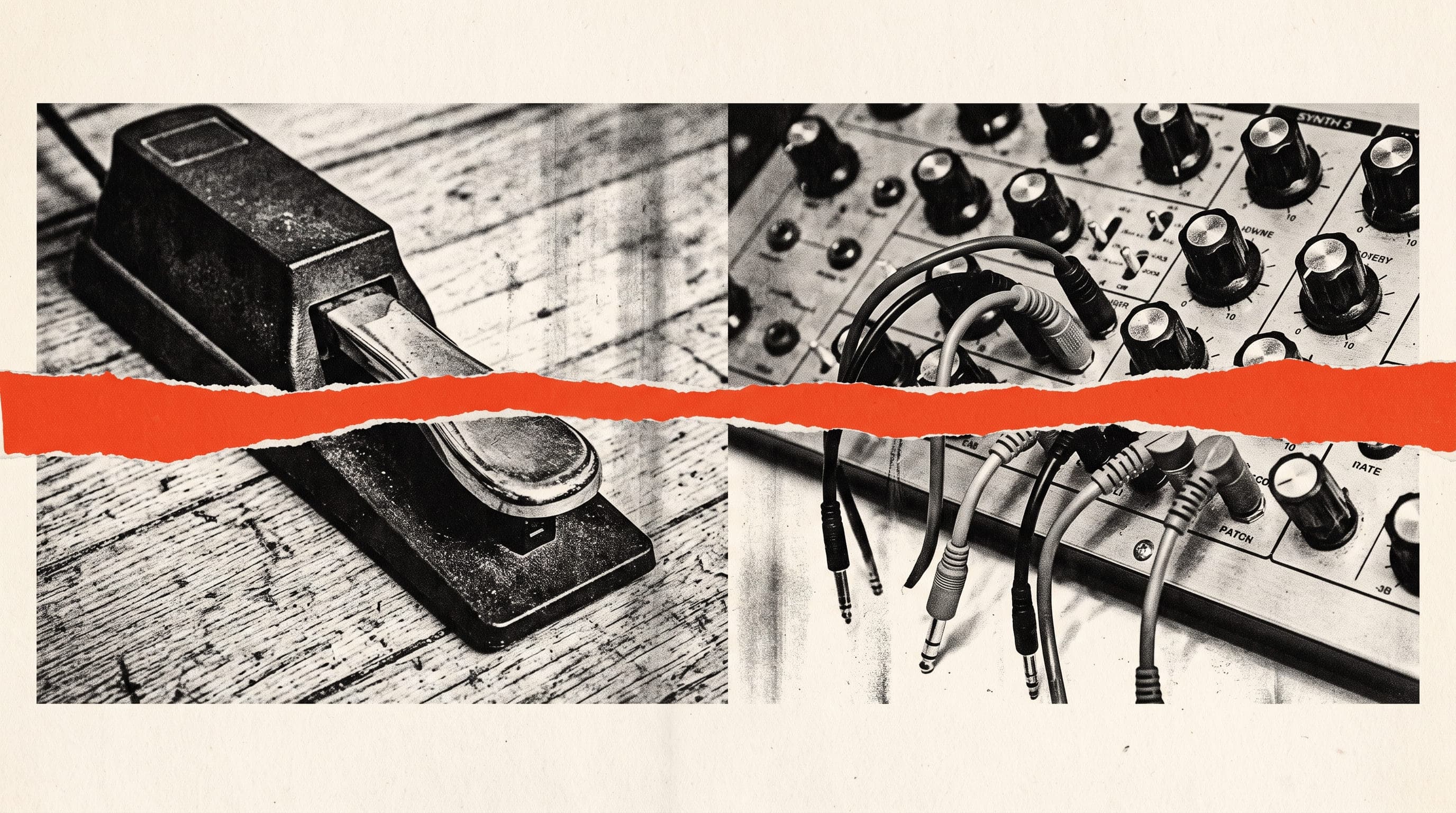
Plenty of keyboards come with a small plastic pedal in the box. It slides around under your foot and usually only works as on or off. A piano-style sustain pedal is heavier, stays put and feels much closer to a real piano.
The headphone output is the biggest advantage a digital keyboard has over an acoustic piano. Being able to practise late at night in a flat is, for a lot of people, the difference between practising regularly and not. The clatter of the keys and the thump of the pedal can still travel to the neighbours below, so stand the keyboard on a rug rather than bare floor.
One thing band keys players often struggle with is remembering which sound goes where in each song. In BandUp you can add personal notes and a setup list to every song, visible only to you, something like "intro: electric piano, chorus: organ". Stage Mode shows those notes in setlist order on the same screen, without digging through menus.
Buying your first keyboard second-hand? Test every single key, and see what else to check when buying a used instrument.