BandUp
Ukulele Tuner

Ukulele Tuner

Tune your ukulele by microphone and catch its bright tone. A chromatic tuner — GCEA, low G and baritone all work the same way.

—

Allow the microphone and play a string to start tuning.

How to tune a ukulele

An online ukulele tuner listens to your uke's bright tone through the microphone and shows each string's note along with how many cents it is off. In re-entrant tuning the G string sits higher than the rest; the tuner reads it as it is, so you never pull a string to the wrong octave. Allow the microphone, play a string and turn the peg gently until the needle reaches the middle.

Because it is chromatic there is no tuning to select: standard GCEA, low G and baritone are all tuned the same way — find the note each string should reach in the table below. In standard tuning the top G string is thinner than its neighbour (re-entrant); the tuner reads that as it is, so all you need to watch is which G you are heading for. A tuned ukulele rings out clearly in the mix and everyone settles on the same pitch from the first song.

String notes and frequencies

The tuner is chromatic — find your target note here, then turn the peg until the needle centres on it. Frequencies are given against A4 = 440 Hz.

Standard tuning

StringNoteFrequency
1G4392.00 Hz
2C4261.63 Hz
3E4329.63 Hz
4A4440.00 Hz

Low G

StringNoteFrequency
1G3196.00 Hz
2C4261.63 Hz
3E4329.63 Hz
4A4440.00 Hz

Baritone

StringNoteFrequency
1D3146.83 Hz
2G3196.00 Hz
3B3246.94 Hz
4E4329.63 Hz

Frequently asked questions

The tuner can't hear my microphone. What should I do?
Your browser needs to grant permission first. Click the padlock icon at the left of the address bar, set "Microphone" to "Allow" and reload the page. If the needle still doesn't move: make sure the right microphone is selected and that its input volume isn't muted. Background noise throws the reading off too, so try a quiet room. On an acoustic guitar bring the sound hole close to the mic; on an electric, point it at your amp's speaker.
What does a chromatic tuner mean?
A chromatic tuner doesn't expect a preset tuning: it listens to whatever you play and names the closest note as it is, with the semitone below and above shown alongside. In practice that means it works with any tuning. Standard, drop D, a baritone ukulele or a 5-string bass: all you need is to know the note each string should reach, then turn the peg until the needle centres on it.
Can I tune without granting microphone access?
No. The tuner works out the pitch by analysing sound from your microphone, so it can't read anything without permission. The interface stays available, so you can still use the string table and note reference on this page. The permission applies only to this tab, and no audio is sent anywhere or stored: the whole analysis happens inside your browser.
What are the ukulele string names and notes?
Standard ukulele tuning is GCEA: G4 (392.00 Hz), C4 (261.63 Hz), E4 (329.63 Hz), A4 (440.00 Hz). The thing to notice is that the top G string is higher than the C string next to it. This is called re-entrant tuning, and it's where the ukulele's bright, jangly ring comes from. So the strings don't run in order from thick to thin; when tuning, go by each string's own note.
What's the difference between low G and high G?
In standard (high G) tuning the G string sits a tone below the A string and is tuned to G4 (392.00 Hz), which gives the bright, re-entrant sound. In low G the same string goes down an octave to G3 (196.00 Hz), usually with a thicker string fitted. Low G gives the ukulele a lower register closer to a guitar's. The tuner reads both, since it names whatever you play; just keep an eye on which G you're heading for.
How do I tune a baritone ukulele?
A baritone ukulele is tuned DGBE instead of the standard GCEA: D3 (146.83 Hz), G3 (196.00 Hz), B3 (246.94 Hz), E4 (329.63 Hz). That's exactly the same as a guitar's top four strings, so if you play guitar your chord shapes carry straight over. A baritone sounds deeper and mellower, and it isn't re-entrant: the strings run properly from thick to thin.
bandup.io/stage
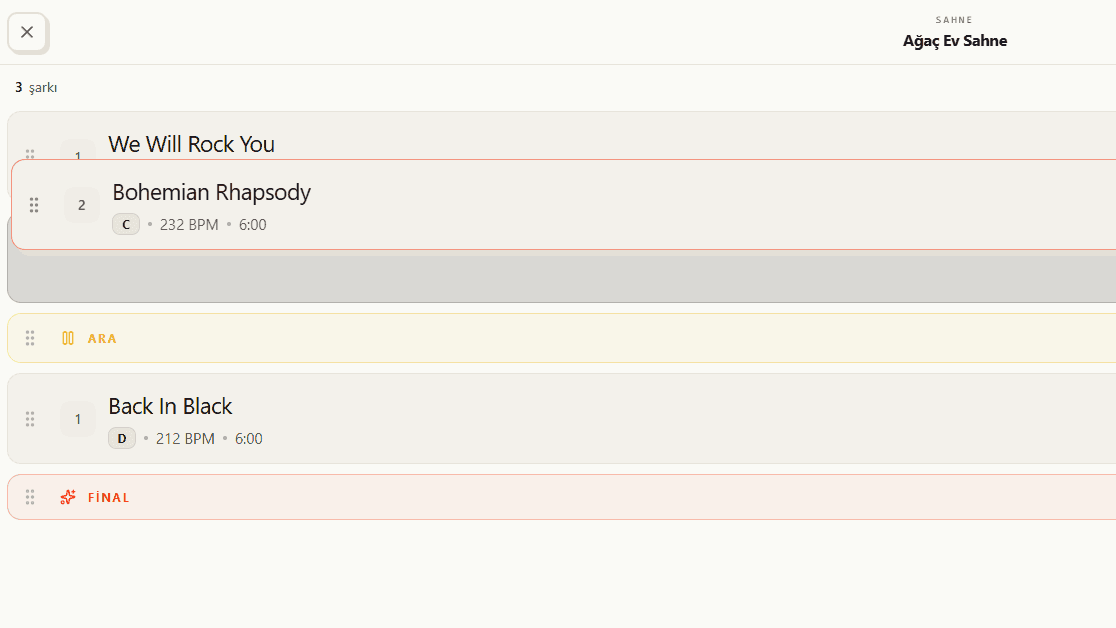
Setlist — drag-and-drop ordering and live duration
Setlist

Now to what you'll play

Your ukulele is tuned and the bright tone is ready. So what are you playing? In BandUp's setlist you drag songs into order, watch the running time live and keep the whole band on the same running order.

See the feature

No one asks what's next.

Set up your band, build your first setlist in two minutes.

Set up your stage