
BandUp
Ukulele Chords

Ukulele Chord Charts

Find ukulele chord shapes on a diagram. Pick a root and type and see where your fingers go across four strings. No sign-up or download required.

Root
Type
C

How to read a ukulele chord chart

A ukulele chord diagram shows the uke's four-string neck: the vertical lines are the strings (G C E A in standard tuning) and the horizontal lines are the frets. A dot marks where to press a string and an O above it means play it open; a thick bar is a barre, where one finger holds all four strings at the same fret.

You pick a root note (C, G, D...) and a chord type (major, minor, 7, m7, maj7) at the top and the diagram draws the shape. The ukulele's G string is re-entrant, so it sits higher than the others, but that does not change the reading: still one note per string. The most common chords like C, F and G come open near the nut, the rest as low barre shapes. Share the shape with your band and everyone lands the same bright tone.

Frequently asked questions

How do I read a chord diagram?
The diagram is a top-down view of the neck. The vertical lines are the strings and the horizontal lines are the frets. Where there's a dot, you press that string at that fret. An O above a string means play it open: no finger, just strike it. An X means don't play that string at all. A thick line across several strings is a barre. The top of the diagram faces the headstock, the bottom faces the body.
Which chord types can I find?
You pick a root note and a chord type to see the diagram. This tool offers five: major, minor, 7, m7 and maj7. Between them they cover most of the bass and ukulele repertoire: major and minor are the basic colours, and the sevenths bring a blues, funk and jazz flavour. Change the root and the same type moves with it. For a wider list of types, try the guitar or piano chord tool.
The ukulele's G string is thinner. Does that change the diagram?
It doesn't. In standard ukulele tuning the top G string is thinner than its neighbour (re-entrant tuning), but the reading stays the same: the leftmost vertical line is the G string, then C, E and A. The dots tell you which string to press at which fret; whether a string is thick or thin doesn't change where your fingers go. What re-entrant tuning changes is the sound: the same shape, notes in a different order.
bandup.io/stage
Setlist — break and finale blocks
Setlist

Keep your running order clear

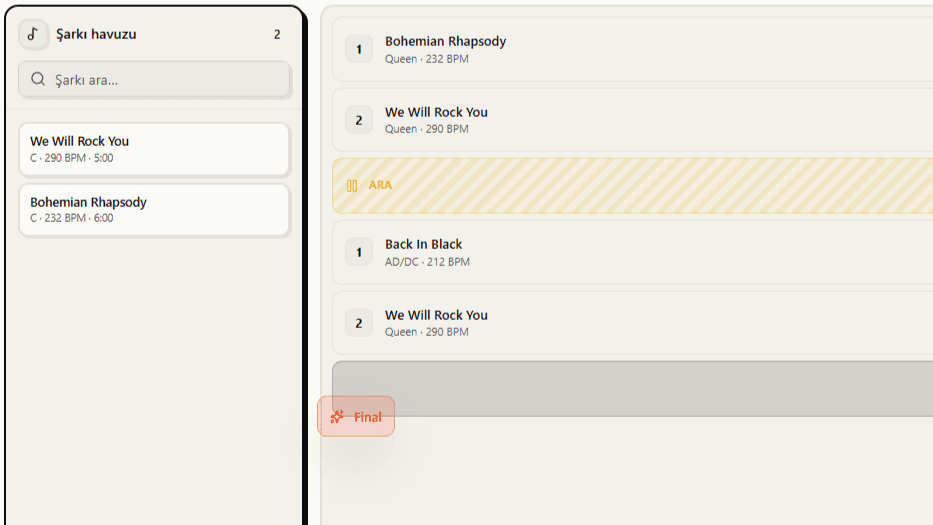
You worked out the chord. The real job is planning the whole set: BandUp's setlist drags songs into order, marks your breaks and the encore, and shows the whole band the same running order, so nobody guesses what's next at rehearsal or on stage.

See the feature

No one asks what's next.

Set up your band, build your first setlist in two minutes.

Set up your stage