BandUp
Guitar Chords

Guitar Chord Charts

Find guitar chords as fretboard diagrams. Pick the root note and chord type and see the finger positions. Free in your browser with no sign-up.

Root
Type
C

How to read a guitar chord chart

A chord diagram shows the guitar neck: the vertical lines are the strings from thick to thin, and the horizontal lines are the frets. A dot tells you to press that string at that fret; an O above a string means play it open, and an X means do not play it (muted). A thick bar is a barre, where one finger presses several strings at the same fret.

Pick the root note (C, G, D...) and the chord type (major, minor, 7, m7, maj7) above, and the diagram shows that chord's shape. Open chords (E, A, C, G, D) appear near the nut at low frets, and the rest come as low-position barre chords. Once you learn a chord and bring it to your band, everyone presses the same shape in the same place and the song sits tight.

Frequently asked questions

What's the difference between tuning and a chord?
Two things that are easy to mix up. Tuning is bringing each string to the right pitch so the instrument is ready to play; that's what the tool on this page does. A chord is several notes sounded together (C major, A minor and so on). So you tune first, then you play chords. If the tuning is off, the chord won't sound right either. For chord shapes, have a look at the Guitar Chords tool.
How do I read a chord diagram?
The diagram is a top-down view of the neck. The vertical lines are the strings and the horizontal lines are the frets. Where there's a dot, you press that string at that fret. An O above a string means play it open: no finger, just strike it. An X means don't play that string at all. A thick line across several strings is a barre. The top of the diagram faces the headstock, the bottom faces the body.
Which chord types can I find?
You pick a root note and a chord type to see the diagram. There are ten: major, minor, 7, m7, maj7, sus2, sus4, dim, aug and add9. Between them they cover almost all of the pop and rock repertoire: major and minor are the basic colours, the sevenths give a blues and funk flavour, sus chords a sense of transition, and dim and aug build tension. Change the root and the same type moves with it.
bandup.io/stage
Stage Mode — lyrics and chords on one page
Stage Mode

Your chords in plain sight on stage

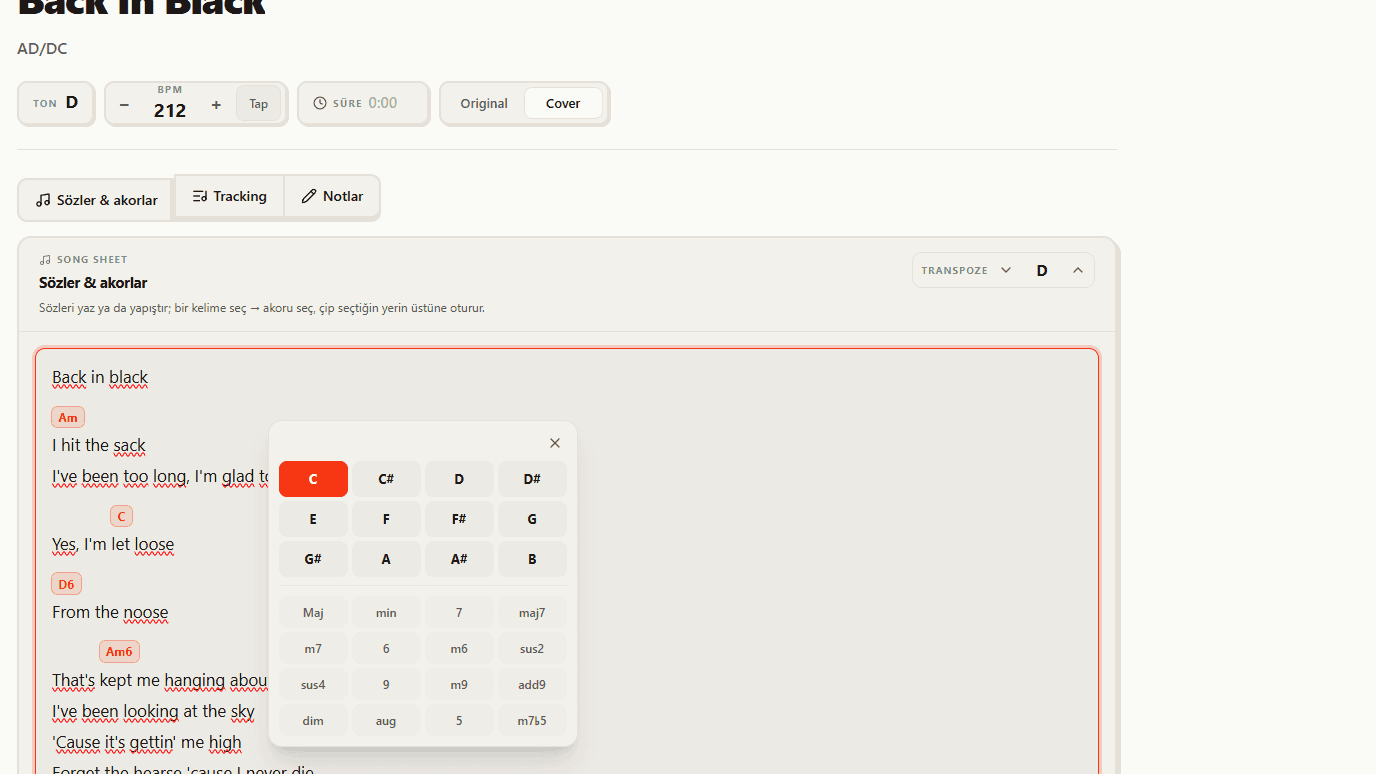
You learned the chord. No flipping through notebooks on stage: BandUp's Stage Mode keeps the song's lyrics and chords on one screen, large and readable, so the whole band follows the same page.

See the feature

No one asks what's next.

Set up your band, build your first setlist in two minutes.

Set up your stage