BandUp
Bass Chords

Bass Guitar Chord Charts

Find bass guitar chords as fretboard diagrams. Pick a root and type across four strings and see where your fingers go. No download, runs in your browser.

Root
Type
E

How to read a bass chord chart

A bass chord diagram shows the bass's four-string neck: the vertical lines are the strings from thick E to thin G, and the horizontal lines are the frets. A dot marks where to press a string, and an O above it means play that string open. The diagram looks narrower than a guitar's because there are two fewer strings, but it reads exactly the same: one note per string.

Pick a root note (E, A, G...) and a chord type (major, minor, 7, m7, maj7) at the top, and the shape starts from the root on the low E string. On bass you often just play the root, yet knowing the full chord fills out your part and keeps you on the same page as the guitar. Bring the shape to your band and the rhythm section plays off the same foundation.

Frequently asked questions

How do I read a chord diagram?
The diagram is a top-down view of the neck. The vertical lines are the strings and the horizontal lines are the frets. Where there's a dot, you press that string at that fret. An O above a string means play it open: no finger, just strike it. An X means don't play that string at all. A thick line across several strings is a barre. The top of the diagram faces the headstock, the bottom faces the body.
Which chord types can I find?
You pick a root note and a chord type to see the diagram. This tool offers five: major, minor, 7, m7 and maj7. Between them they cover most of the bass and ukulele repertoire: major and minor are the basic colours, and the sevenths bring a blues, funk and jazz flavour. Change the root and the same type moves with it. For a wider list of types, try the guitar or piano chord tool.
Do you play chords on bass?
Most of the time the bass's job is to hold the root of the chord. It sets the bottom of the band and carries the floor along with the drums. But knowing the whole chord still helps: once you know which notes are in it, you can step off the root into walking lines and passing notes. That's why the diagrams are here: not to strum the chord, but to see inside it. In a busy arrangement a full chord can muddy the sound.
bandup.io/stage
Tech Rider — song list and contacts
Tech Rider

Your songs clear for the crew too

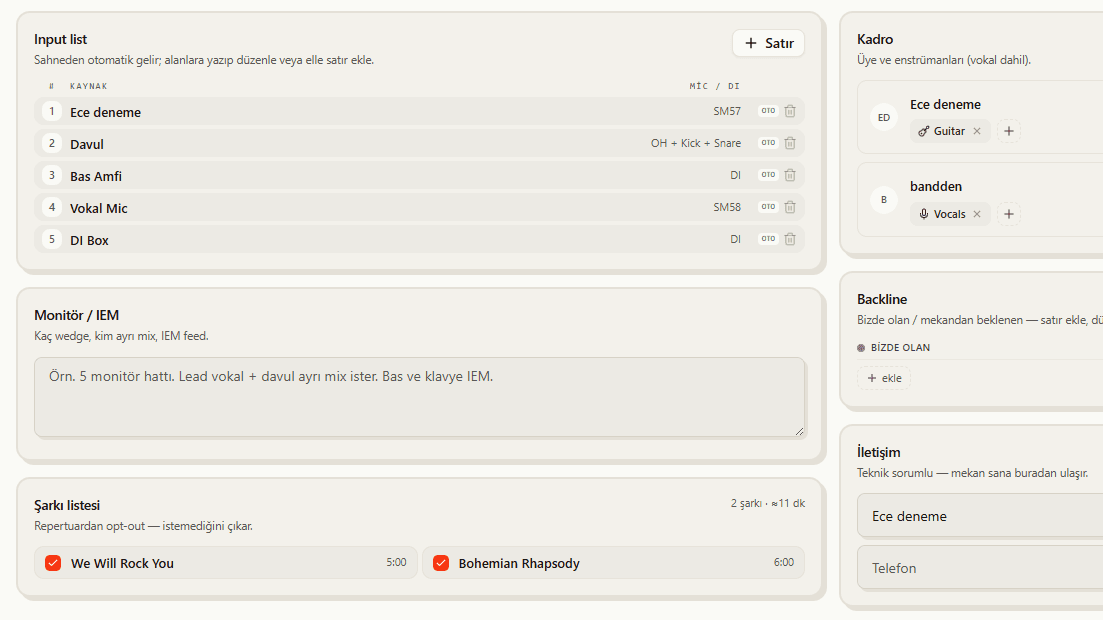
You learned the shape and the part is ready. On stage the next job is briefing the crew: BandUp's tech rider gathers your set's song list and the band's contact details on one page, so the sound engineer knows what you're playing and who to reach, and setup is never guesswork.

See the feature

No one asks what's next.

Set up your band, build your first setlist in two minutes.

Set up your stage