
What Is Jazz? Where to Start Listening
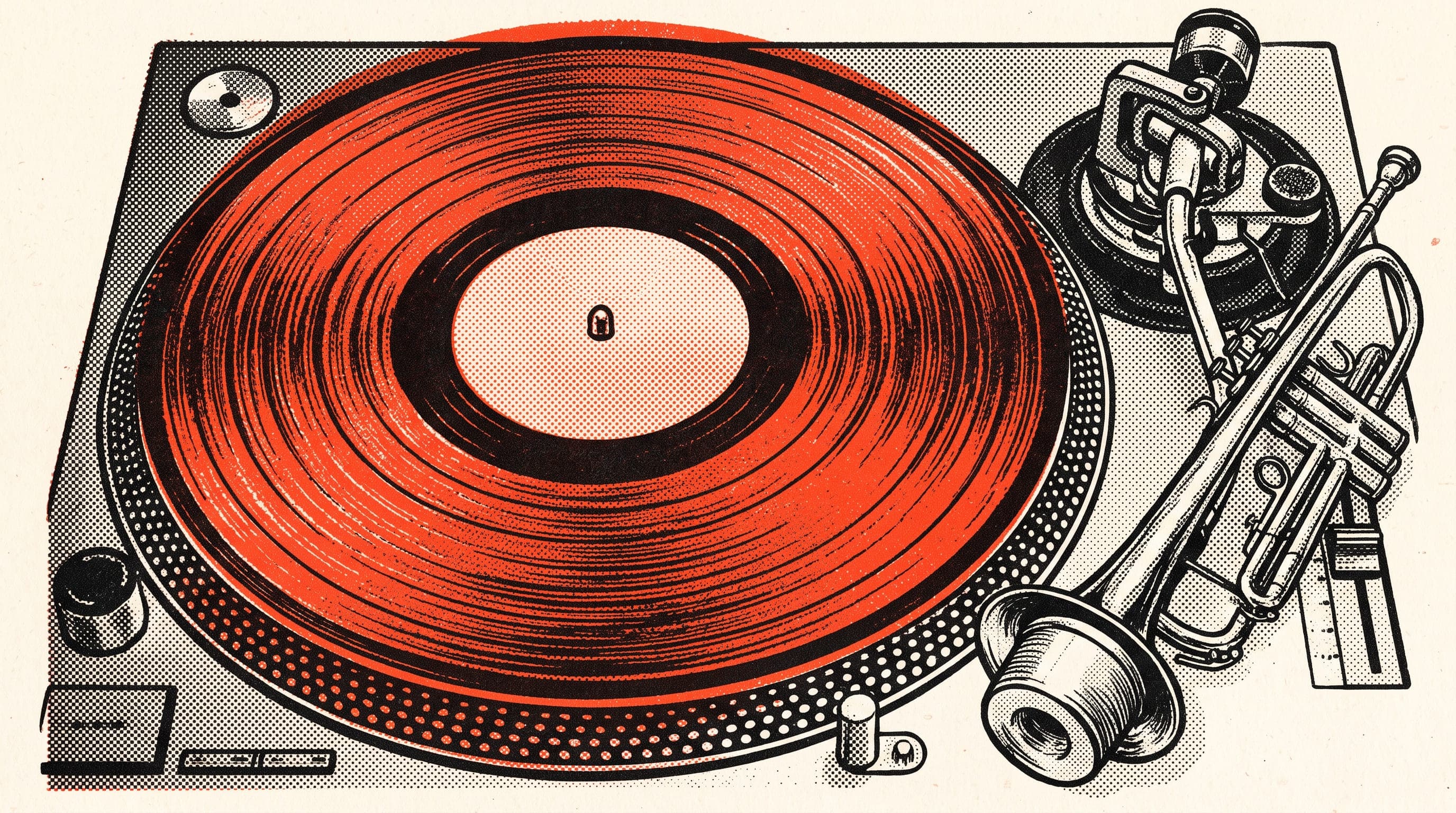
In February 1917, a five-piece band from New Orleans recorded a tune called "Livery Stable Blues". It is generally recognised as the first jazz record ever released commercially. Jazz itself is older than that record. It grew out of African American communities in New Orleans in the late 19th century, pulling together blues, ragtime and brass band music, with improvisation and swing feel at its core.
Tell someone you want to get into jazz and you will often get a long list of albums back. At the top, an experimental record from the late 1960s. Right under it, a crackly recording from the 1920s. Play them back to back and you might ask "is this even the same music?" and give up there. Jazz has more than a century of history, with eras that sound nothing alike, and the order you listen in affects whether it clicks.
Why do swing feel and improvisation matter so much in jazz?
Two things set jazz apart. The first is swing: eighth notes played not evenly but with a long-short feel. Two notes that look identical on paper come out one a little longer, one a little shorter. It is hard to write down precisely. You learn it by ear. That feel is carried by the groove the drums and bass lock into.
The second is improvisation. In a jazz tune, a lot of what the players do is built on the spot. But that doesn't mean anything goes. Most jazz tunes rest on a set form and chord progression, and improvisation happens inside that frame. The soloist moves over the chords while the rhythm section holds the chords and the form. Hear the same tune two nights running and you get two different solos, but it is still the same song.
What is a "standard", and why does everyone play the same tunes?
Jazz musicians share a common songbook. The tunes in it are called standards. Many of them started life in musicals and popular songs from the first half of the 20th century, and jazz players reworked them over the years into a shared language.
The beauty of standards is that musicians who have never met can get up together at a jam night, call a tune and start playing. Everyone knows the chords and the form. The rest is that night's take. A standard usually runs like this:
- Head: the melody is played through once.
- Solos: players take turns improvising over the same chord progression, one or more times round each.
- Head out: the melody comes back and the tune ends.
Blues is a big part of that shared language too. The 12-bar blues form is where jazz and rock players meet, and it is the pattern you hear most at jam nights.
From swing to fusion, what does each era sound like?
Jazz is not one sound. The table gives a rough order of the main eras. Dates are approximate and the eras overlap.
| Era | Roughly | What it sounds like |
|---|---|---|
| Early jazz, New Orleans | 1910s and 1920s | Several instruments weaving melodies at once, a busy, joyful sound |
| Swing, big band | 1930s | Big orchestras, arranged, made for dancing |
| Bebop | 1940s | Fast tempos, complex chords, small groups, long solos |
| Cool jazz | Late 1940s, 1950s | Calmer, softer tones |
| Hard bop | 1950s | Blues and gospel influence, a harder, earthier sound |
| Free jazz | Late 1950s, 1960s | Loosened form and harmony, experimental |
| Fusion | Late 1960s onward | Electric instruments, rock and funk rhythms |
Bebop was shaped by players like Charlie Parker and Dizzy Gillespie. The idea that jazz is mellow background music doesn't survive this table. Bebop and free jazz can hit the listener as intense and fast.
Which album should a first-time jazz listener start with?
There is no single right list. But a good way to tune your ear is to start with records that have memorable melodies and capture the general sound of their time, then work towards denser ones. These four are often recommended and well documented:
- Miles Davis, Kind of Blue (1959): often cited as one of the best-selling jazz albums of all time. Calm, spacious and easy to follow. A great way to hear how improvisation is built over simple chords.
- Dave Brubeck Quartet, Time Out (1959): an album that plays with unusual time signatures. If you know Turkish aksak rhythms, parts of it may feel familiar.
- Stan Getz and João Gilberto, Getz/Gilberto (1964): where jazz meets bossa nova, soft and melodic.
- John Coltrane, A Love Supreme (1965): denser and more spiritual. Easier to take in after the first three.
Pick the one you like most and move on to that artist's other records. It maps out a better route than working through a random list.
One small listening habit helps a lot: play the same track a few times, following a different instrument each time. Just the bass on one pass, the drums on the next, the soloist after that. Jazz can sound scattered at first. Focus on one instrument and you start hearing how everyone answers each other inside the same form. If you play, it is also a good way to see how your own part could sit inside a band.
How can a band approach a jazz standard at rehearsal?
When a pop or rock band tries a standard, the biggest difference is that the tune is never played the same way twice. A few steps to prepare:
- Map the form. How many bars, which sections, how many solo choruses? Don't start until everyone knows.
- Learn the chord progression. The patterns that keep showing up in standards are richer versions of chord progressions you probably already know.
- Agree the solo order up front, and decide how you will cue the handover from one solo to the next.
- Plan the ending. After the head out is where jazz tunes most often fall apart.
Where can you hear jazz in Turkey, and who should you listen to?
The Istanbul Jazz Festival has been run by the Istanbul Foundation for Culture and Arts every summer since 1994 and is one of the most visible meeting points for jazz in the country. In the big cities, clubs with regular jazz programmes and jam nights are a good way in, whether you want to listen or join in.
Turkey's own jazz history is worth exploring too. Recordings by players such as İlham Gencer, Maffy Falay and Okay Temiz are a good place to start. Sevda, the group Falay and Temiz formed in Sweden, made records that brought Turkish melodies and rhythms together with jazz. Arif Mardin, the producer and arranger who built a long career in New York, is another important name who came from Turkey.