
Dynamic vs Condenser Microphones: What's the Difference?
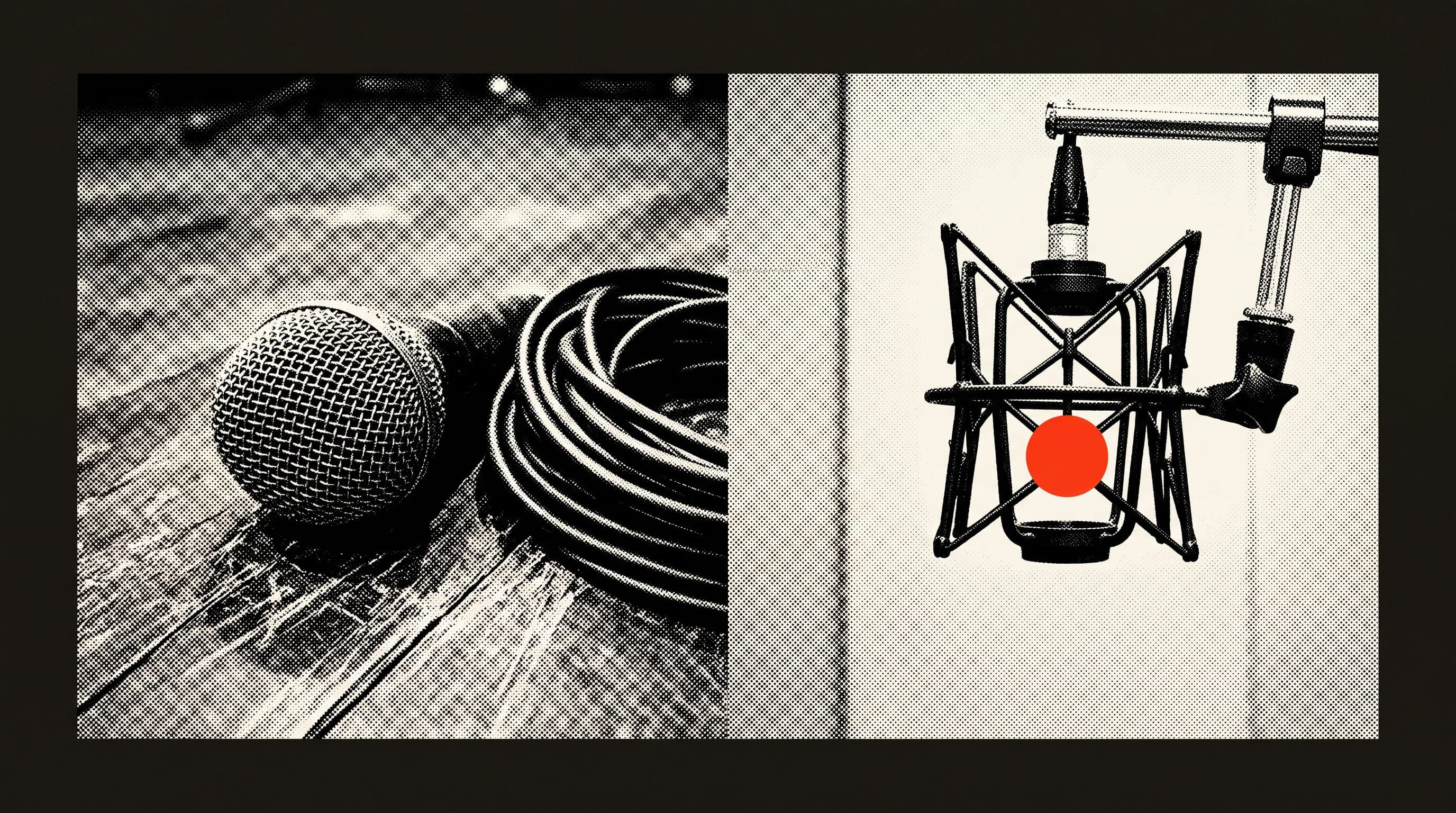
Dynamic and condenser microphones turn sound into an electrical signal in two different ways. A dynamic mic is tough, needs no power and handles high volume. A condenser is more sensitive and catches more detail, but needs power to work. That difference also decides which one does a better job on stage and which at home.
A link drops into the band chat: "Getting a mic for home recording, this one?" Someone says "get a condenser, studio sound." Someone else: "get a dynamic, it won't pick up the room." They're both partly right. Sound familiar?
How does a dynamic mic work?
Inside a dynamic mic there's a thin diaphragm with a coil attached. The coil sits inside a magnet. When sound makes the diaphragm move, the coil moves through the magnet, and that movement creates the signal.
It's a passive design, so the mic needs no extra power. Being simple makes it tough: it survives drops, damp and very loud sources. It's less sensitive, so it picks up less distant sound and room echo. On stage that's a plus, because the mic hears what's in front of it and less of the rest of the stage.
How does a condenser mic work?
In a condenser, a very thin diaphragm sits right next to a fixed metal plate. As sound moves the diaphragm, the gap between them changes. Electronics inside the mic turn that change into a signal.
That circuit needs power. It's called phantom power, usually 48 volts, and the mixer or audio interface sends it down the mic cable. The "48V" button on the device switches it on and off. Check for that button when you pick an interface; our audio interface guide covers the other features.
Because the diaphragm is so light, a condenser catches small details, breath, string tone and sharp transients better. Its frequency range is wider too. But the same sensitivity hears everything else in the room.
What are the main differences?
| Dynamic | Condenser | |
|---|---|---|
| Power | None needed | Needs phantom power (48V) |
| Sensitivity | Lower | Higher |
| Detail | Less, a "tighter" sound | More, a more open sound |
| Room sound | Picks up little | Picks up a lot |
| Loud sources | Handles them easily | Depends on the model |
| Durability | Very tough | More delicate |
| Typical use | Stage, amps, drums | Studio, quiet rooms, acoustic instruments |
Which is better for recording at home?
Depends on your room. A condenser records vocals beautifully in a treated, quiet room. But in a bare-walled, empty bedroom the same mic also records the reflections off the walls, the car outside and your laptop fan. You get a detailed sound that very clearly happened in a room.
That echo usually can't be fully cleaned up afterwards.
A dynamic gives a drier, more controlled sound in that same room because it picks up less from a distance. You need to stay close to it, and it needs more gain, meaning a higher level on your interface.
Whichever you pick, a pop filter helps with vocals. A thin mesh in front of the mic breaks up the burst of air on "p" and "b" sounds. Those bursts show up on the recording as a dull thump and are hard to clean up later.
Short answer: quiet, somewhat treated room, go condenser. Untreated and noisy, a dynamic is the safer start. Our guide to recording vocals at home shows how to improve a room with a wardrobe and some blankets, and the home studio guide covers the overall setup.
Large vs small diaphragm condensers: what's the difference?
Condensers come in two main types too. Large-diaphragm ones give a fuller low end and a warmer, bigger sound. They're the classic studio vocal choice. Small-diaphragm ones react faster to sharp sounds and sound more natural and accurate. They're common on acoustic guitar, cymbals and drum overheads.
What does the polar pattern change?
No mic picks up equally from every direction. That's its polar pattern, and it decides where the mic should go:
- Cardioid: Picks up from the front, little from behind. Most stage vocal mics work this way. Put the monitor behind the mic and feedback risk drops.
- Supercardioid: A narrower pickup, with a small sensitive spot at the back. The monitor goes slightly to the side, not directly behind.
- Figure-8: Picks up front and back, not the sides. Handy for recording two singers facing each other on one mic.
- Omni: Picks up equally all round. Useful when you want the room in the sound.
Which mic for which source?
| Source | Common choice | Why |
|---|---|---|
| Vocals on stage | Dynamic, cardioid | Tough, resists feedback |
| Vocals in the studio | Large-diaphragm condenser | Detail and warmth, if the room is quiet |
| Guitar amp | Dynamic | Handles high volume easily |
| Snare and toms | Dynamic | Takes hard hits |
| Kick | Large-diaphragm dynamic | Handles deep, loud sound |
| Cymbals, overheads | Small-diaphragm condenser | Fast and detailed |
| Acoustic guitar | Small or large-diaphragm condenser | Catches tone and detail |
These are common picks, not rules. Plenty of studios record vocals on dynamics, and some singers use condensers on stage.
What's a ribbon mic, and what should you watch out for?
There's a third type: the ribbon mic. Inside, a very thin strip of metal hangs between magnets. It sounds smooth and warm and is usually figure-8. But that ribbon is fragile.
Passive ribbon mics can be damaged by phantom power. The risk usually comes from the surge when a cable is plugged in or pulled out with 48V on, or from a faulty cable. Balanced dynamic mics aren't affected by phantom power. The safe habit is simple: switch 48V off before plugging or unplugging any mic.
What are the most common mistakes?
- Recording with a condenser in an untreated room, then complaining about the echo.
- Standing too far from a dynamic. It likes you close, and a hand's width or two away the sound thins out.
- Plugging in a condenser, forgetting 48V and deciding the mic is broken.
- Putting the stage monitor in front of the mic. A cardioid picks up from the front, and that's exactly where the monitor is pointing.
- Thinking an expensive mic will fix everything. The room and the mic position usually make more difference than the mic itself.
Checking that mics are set up right during soundcheck is much easier than finding out once the show has started.