
Practising Drums at Home: Practice Pad or Electronic Kit?
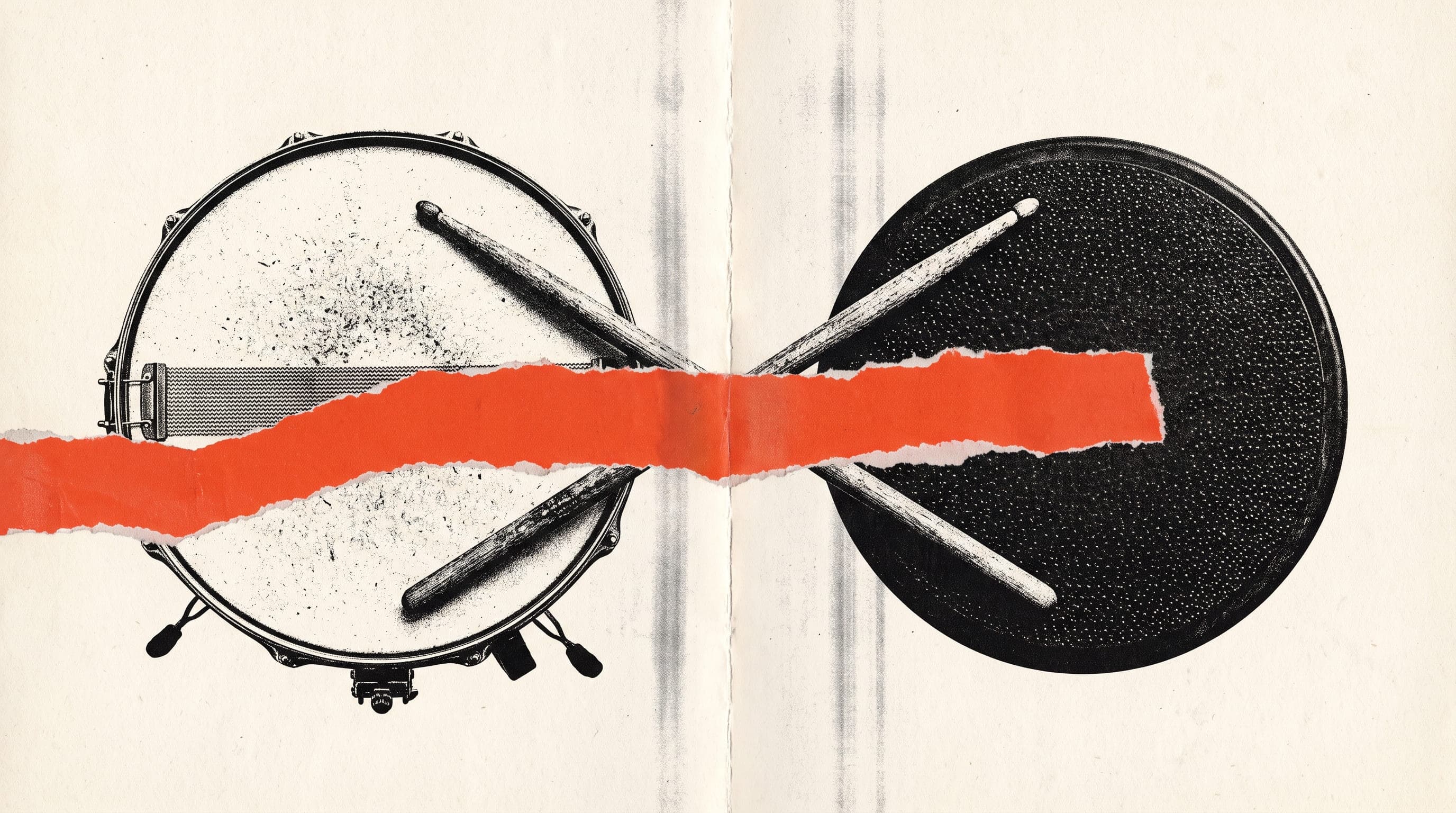
There are three main ways to practise drums at home: a practice pad, an electronic kit and a quietened acoustic kit. All three cut the noise reaching your neighbours. But each one trains something different, each one leaves something out, and none of them makes the sound disappear.
The electronic kit is set up, headphones on, and all you can hear in the room is the tap of the sticks. Next day, the downstairs neighbour knocks: "What were you banging last night?" What you never heard in your headphones was the kick pedal thumping into the floor. The real question when you practise at home is which way the sound travels.
How does drum noise reach the neighbours?
Drum sound travels two different ways, and they need different fixes.
- Through the air: The sound of sticks hitting heads and cymbals. It goes through walls, windows and doors. Pads, mesh heads and low-volume cymbals cut most of it.
- Through the floor: The impact of the kick and hi-hat pedals. A concrete floor carries that vibration straight downstairs. Headphones do nothing for it, because it isn't coming from the headphones, it's coming from the floor.
In apartments, the second one usually gets the complaints. So whatever gear you choose, you need to think separately about how your feet meet the floor.
What does a practice pad train, and what doesn't it?
A practice pad is a small surface with a rubber or mesh top that you hit with sticks. It's the quietest and cheapest option at home. It's also the best tool for hand technique: how the stick rebounds, evening out both hands, basic rudiments and keeping time with a metronome.
When choosing a pad, look at the surface. Hard rubber gives the stick more rebound and makes playing easier. A softer surface pushes the stick back less, so your wrists and fingers do more of the work. Some pads sit on your knee, others mount on a snare stand. A stand-mounted pad puts you closer to the height and angle of the snare on a real kit.
What it leaves out is just as clear. No feet, no cymbals, no moving around a kit. So it doesn't train four-limb coordination or cymbal feel. Think of the pad as your daily hands workout, not your main instrument. Pad time gets far more useful when you practise with a metronome.
Are electronic drums actually quiet?
Much quieter than an acoustic kit, but not silent. The tap of sticks on the pads can be heard even by someone in the same room. The big issue is the pedal again. When you hit the kick pad, the impact goes through the floor, and the thud is what people downstairs hear most.
A big plus of an electronic kit is playing along to recordings. Many modules have an audio input for a phone or computer. With the song and your own playing both in your headphones, you can run the setlist from top to bottom. That's something a pad can't give you.
Electronic kits usually come with one of two pad surfaces:
| Mesh pad | Rubber pad | |
|---|---|---|
| Stick noise | Lower | Higher, a harder click |
| Rebound | Closer to an acoustic head | Harder and bouncier |
| Adjustment | Tension can be adjusted | None |
| Durability | The head can change over time | More durable |
If you're in an apartment, mesh pads on at least the snare and toms make a clear difference to what the neighbours hear.
Can you quieten an acoustic kit?
If you already have an acoustic kit at home, you can't make it silent, but you can bring it down a lot. Every method has a trade-off:
- Mute pads: Rubber covers that sit on the heads. They cut a lot of volume but soften the stick's rebound. The kick drum versions are less effective, and their thickness can mess with pedal technique.
- Mesh heads: Woven heads you fit on the acoustic kit. They cut the sound dramatically, but the feel is different and it gets harder to hear your own mistakes when playing along to music.
- Low-volume cymbals: Perforated or special-alloy cymbals, much quieter than normal ones. They keep the feel of hitting metal, so your cymbal technique stays intact.
How do you cut kick pedal vibration?
The best-known way to stop the impact reaching the floor is a platform that lifts the kit off it. The most common DIY version is a layer of tennis balls between two rigid boards. The balls absorb the hit and less of it reaches the concrete. It's cheap and it works, but it has limits: the balls go flat over time, new and old balls aren't equally firm, and some of the impact still gets through.
A few habits help alongside the platform: easing off on the pedal, switching from feet to hands-on-the-pad later in the evening, and not setting up against a shared wall or above the downstairs bedroom.
Does home practice get you ready for rehearsal?
Quiet practice at home saves time at rehearsal, but it doesn't replace a real kit. Three things you meet at rehearsal aren't there at home: the sound and feel of real cymbals, a dynamic range from very soft to very loud, and playing in a loud room while hearing the band. So alongside home practice, get on a real kit now and then. Even a short studio slot makes a real difference, and having a plan for rehearsal studio time helps.
It helps to plan the evening before rehearsal around this. Work through the transitions and hard parts of a new song at home, along with the recording. Leave what needs a real kit, like cymbal changes and dynamics, for rehearsal.
Practising to the band's setlist at home is what saves the most time at rehearsal. In BandUp, each song's BPM and key sit on the song card. The visual metronome in the song view flashes the beat count at the song's BPM. Keeping the band's tempo at home too means fewer "was that a bit fast?" moments at rehearsal.
What about the rules in your building?
Noise rules for home practice vary a lot by country, city and building, and the "no noise after a certain hour" rule people quote isn't always written into law. In Turkey, for example, the Condominium Law obliges residents not to disturb each other, while specific hours, where they exist, are usually set in the building's management plan. Its environmental noise regulation leaves household activities out of its scope.
In practice, the first step is to check your building's rules or lease and talk to your neighbours to agree practice times together. If a dispute gets serious, a lawyer is the right person to ask. And protect your own ears while you practise. If you practise on an acoustic kit or keep the headphones loud, our guide on earplugs for musicians is worth a read.